











Since its founding, the Relo Group has been expanding its business domains under the aims of solving societal problems and providing convenience by leveraging its unique proprietary functions.
In addition, we have been developing businesses under our partnership management philosophy, in which all employees participate in management with a sense of ownership. We have been proactively working to increase employee ownership, including enhancing the employee shareholding association, with the goal of realizing the sustainable prosperity of the Group and its employees.
To achieve this goal, we have continued to provide customers with high-quality services, thereby creating satisfaction and excitement. This is how we will strive to achieve excellence and sustainable growth.
We will continue striving to do our very best in every situation and occasion to improve our corporate value. At the same time, we will leverage our expanding capabilities to continue operating businesses that are useful to society and people, thus contributing to the establishment of a sustainable society.
<The "3 principles" of the Relo Group>
・With every employee's participation in corporate management, we shall respect each other and together pursue the prosperity of all.
・We shall provide the best possible services to our customers.
・We shall strive to do our very best in every situation and occasion.
At the Relo Group, we started with a mission of solving problems regarding the unoccupied houses of transferees. We have created a business of solving issue after issue faced by clients including those in charge of companies' personnel and general affairs, transferees, small and medium-sized enterprises, regional small and medium-sized hotels and inns, and people who have just relocated and others.
As a provider of solutions to the issues faced by society, we will continue to have all our employees work as one to achieve our mission, under the three principles that we have held since our foundation, so that our efforts will lead to the prosperity of all of our stakeholders, including our shareholders, customers, business partners, and employees.
Governance Structure
In May 2023, the Relo Group established the Sustainability Committee, chaired by the Company's representative director and CEO, with a view to stepping up its sustainability efforts. This committee monitors the activities of each Group company to address sustainability issues, respond to risks and opportunities, and discuss these issues in order to accelerate sustainability-related measures. The Group also established a governance structure in which the Board of Directors receive reporta at least once a year on sustainability-related measures compiled by the Sustainability Committee to monitor and oversee responses to issues, risks, and opportunities.
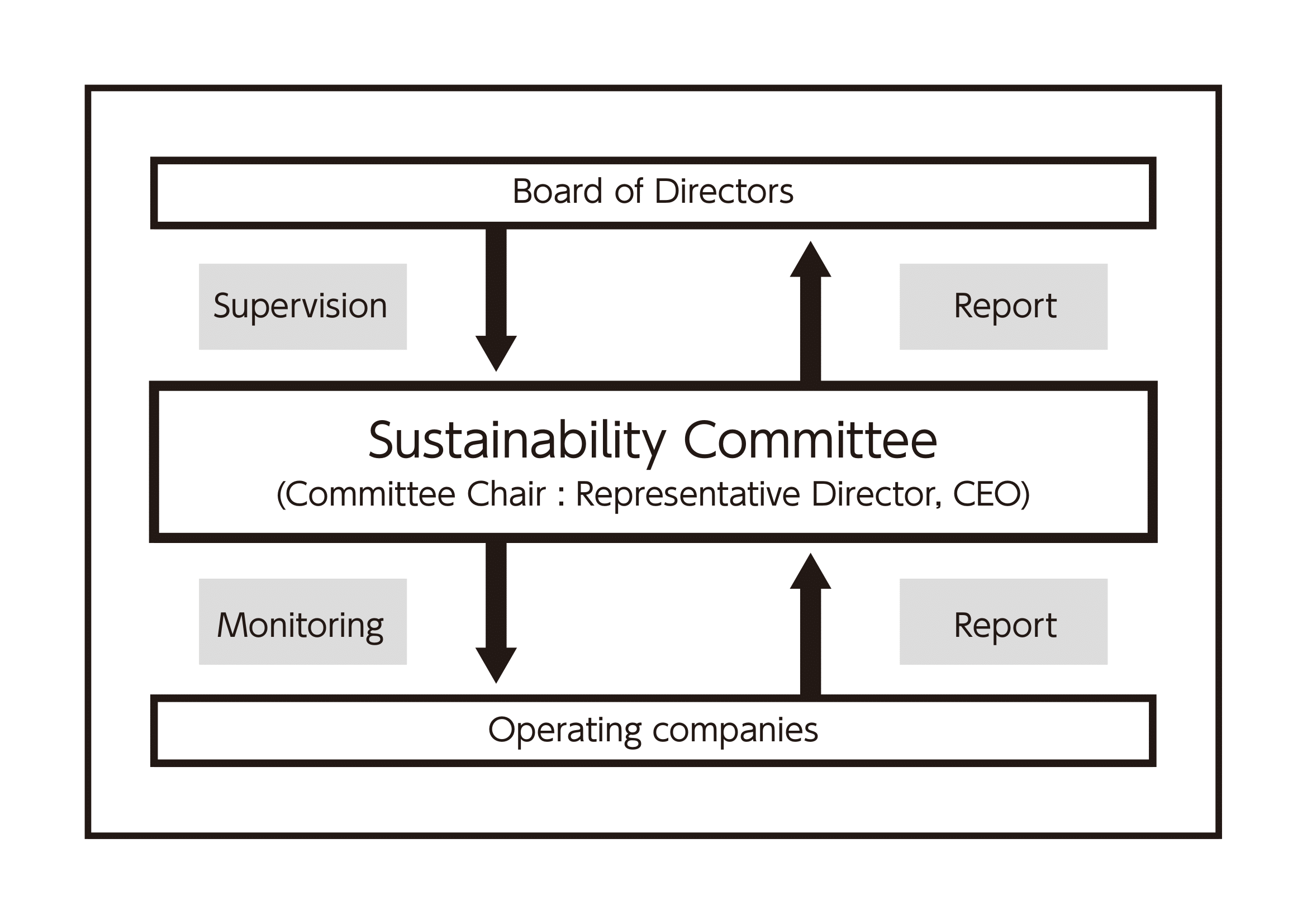
Strategy
The Relo Group has identified five material issues based on the impacts of its business activities on society and the social issues it must address to realize a sustainable society. We have also developed a value creation process for continuous development. We will strive to increase our corporate value by addressing social issues. We will thus seek to facilitate the continuous growth of all our stakeholders as well as the Relo Group and to realize sustained prosperity.
Risk Management
For the purpose of sustainability-related risk management, the Sustainability Committee identifies Groupwide risks and opportunities based on the key social issues the Relo Group must address in light of global changes in society. Then, after evaluating these risks opportunities and discussing appropriate measures, the Sustainability Committee will report them to the Board of Directors for consideration. The content of these reports is reviewed regularly and reported to the Board of Directors as necessary, and the status of countermeasures and progress thereof are monitored, managed, and examined.
Materiality and Value Creation Process
The Relo Group has identified five material issues from among the impacts of its business activities on society and social issues against which it should act for creating a sustainable society. We have also developed a process for constant development, or a value creation process. We will strive to increase our corporate value by addressing different social issues. We will thus seek to attain continuous growth of all our stakeholders as well as the Relo Group and to realize sustained prosperity.
Materiality
Value Creation Process
Human Capital Initiatives
Since its founding, the Relo Group has recruited like-minded employees (partners) who are align with the dreams and visions set out by its founder. We have upheld our partnership management philosophy of achieving the prosperity of both the Company and its employees and taking on the challenge of realizing our dreams and visions through creating an environment where everyone can flourish regardless of gender, nationality, or career backgrounds. To encourage growth, our management philosophy has always been to give employees a stage where they can demonstrate their abilities. These initiatives form an important foundation for developing the human resources necessary to advancing the Group’s businesses, and we have established policies and initiatives to ensure that this strength continues to be utilized.
<Policies for Initiatives>
①Maintain and promote partnerships
By understanding its philosophy and holding shares as partners, each employee develops a sense of
ownership in the Company’s management. We promote management that provides employees with a stage
where they can grow by demonstrating their abilities as partners.
②Maintain high levels of employee engagement by promoting partnerships
Governance
The Relo Group has established the Sustainability Committee to strengthen sustainability initiatives. Human capital is a key element in promoting sustainability and therefore is discussed by the committee as an important matter. The Corporate Human Resources Officer (CHRO) reports to the Board of Directors once a year on the matters discussed and the status of initiatives taken by the committee and works to maximize the value of human capital under the oversight and supervision of the Board of Directors.
Risk Management
| Risk | Opportunities | |
|---|---|---|
| ①Maintain and promote partnerships |
・Risk of slowdown in employee growth due to less intent or ambition to become shareholders with a sense of ownership. ・Risk of slowdown in business growth due to low ambition among employees to take on challenges. |
・Improve awareness of management participation. ・ Foster ambition to take on challenges. |
| ②Improve partner engagement | ・Risk of worsening employee turnover rate due to decline in employee engagement. | ・Improve employee turnover rate by increasing engagement. |
Metrics and targets
The Group has adopted the following quantitative targets to assess its human capital initiatives.
| Targets | Current metrics | |
|---|---|---|
| Employee shareholding association membership rate | Maintain at 90% or more | 98.6% |
| Concurrent managerial positions* | 20% | 30.7% |
*Percentage of those in full-time management positions who concurrently serve as Unit Manager (UM) and Group Manager (GM)
We believe opportunities to advance to management positions provide employees with a stage to demonstrate their abilities. However,when multiple management roles are held by certain individuals, this eliminates the possibility for others to earn such opportunities.
In order to provide employees with a stage to demonstrate their abilities, we must prohibit the concurrent holding of management positions and provide the appropriate training to those who deserve to advance to management roles.
Partnership Management
Partnership management is to unite the strengths of all employees sharing the aspiration of fulfilling the vision for addressing difficulties and for making the vision a reality. We believe that encouraging employees to take part in management as stakeholders and to grow the company and themselves leads to personal development and prosperity. To help realize personal prosperity, we recommend that our employees hold company shares. We adopt the percentage of employees affiliated with the employee shareholding association as an indicator and as a target.
① Sharing management information
・Number of CEO roundtables : 16(in FY2025/3)
・ Number of CEO interviews with individuals : 91 (in FY2025/3)
The CEO roundtable is an open forum for sharing information where any employee of the Relo Group can participate. By engaging in direct conversations with the CEO, who is the Relo Group top executive, it is possible to understand the thinking of top management, and at the same time to increase employee awareness of participation in management. CEO interviews with individuals are person-to-person interviews with employees who have received an award for outstanding performance in the annual or quarterly awards. This interview is an opportunity for top management to directly commend employees for their achievements as well as an opportunity to understand what high achievers are thinking, pick up on good ideas, and to put them into action immediately.
In addition to personal interaction, we also organize an address by the CEO to new employees joining the company every year. We also broadcast video messages to all employees four times a year: A message at the start of the financial year, the RPM* message, a summary of the first half of the financial year, and a New Year message. We also invite newly promoted members to participate in the CEO Seminar, which is part of the graduate recruitment drive, to inform them of the thinking of the top management.
*RPM is short for the annual RELO PARTNER'S MEETING where many Relo Group partners participate to share management policies and philosophy and where the annual awards ceremony is held.
②Shareholding measures
Ownership of company shares is an important factor in partnership management. We are working on various measures to familiarize employees with the ownership of company shares and to provide opportunities to consider their own and the company's prosperity from a medium to long term perspective.
*In fiscal 2023, we implemented temporary incentives to enroll in the employee shareholding association, limited to one year, and we provided additional incentives to everyone who was already enrolled in the association.
| Remuneration | Paid stock options | Prepared as additional remuneration for those who hold positions above a certain level and for employees who have received awards. |
|---|---|---|
| Restricted stock | ||
| Support | Employee shareholding association incentive | In the first year of enrollment in the association, the company will provide incentives in the form of 50% of contributions (with an upper limit) for the purchase of additional shares. *Available to all full-time employees |
| Share purchase loan program | A program that facilitates early ownership of a certain number of shares by lending funds to purchase shares to full-time employees at low interest rates *Available to all full-time employees |
Management That Gives Opportunities
The company has set the idea of "management where employees are given a stage to demonstrate their abilities" and provides its employees with an environment that enables them to play an active role in many stages. We will develop and refine systems that focus on providing opportunities for personal growth and realization, such as a system to challenge new fields and realize career paths through open recruitment across a wide range of categories of business within the Group, and a career vision program that provides an opportunity once a year for employees to think about their career and share with their superiors the direction they seek to take.
①Status of managerial positions
・Number of unit mangers (UM) (department head level)
30s 36 persons (17.7%)40s 96 persons (47.2%)Average age is 45.8
・Number of Group Managers (GM)(section head level)
20s 56 persons (9.0%)30s 193 persons (31.1%)Average age is 41.9
*Figures in parentheses ( ) indicate the proportion of managers in each age group.
*As of March 31, 2025
Based on the idea of management where employees are given a stage to demonstrate their abilities, the Company proactively promotes human resources, regardless of gender and age, promoting employees with high aspirations to managerial positions and positions close to management at an early stage. As a result, the Relo Group continues to generate a high level of vitality.
②Intra-group job posting system
We hold an open recruitment once a year as a system that allows employees to step up to new challenges. The only condition for applicants is that they stay in the position for two years. There are no other restrictions on applications. To protect employees who want try for challenges, the applications are accepted directly at the Human Resource Development Office without passing through the hands of superiors. (The Human Resource Development Office will notify the department after the open recruitment transfer is confirmed.) 88 departments participated in open recruitment for various positions in 2024, providing employees with opportunities to consider their careers.
Optimization of Employee Conditions and Reduction of Engagement Risks
We believe high levels of engagement lead to reductions in employee turnover by fostering a sense of ownership and a
management perspective, two key elements of partnership management. Therefore, we provide job-class-specific training
and training for young employees to create an environment that shapes the foundation for success. We also recognize
successful partners for their contributions through our motivational award system. By actively gathering expressions of
gratitude and appreciation from our customers and sharing them with our employees, we foster a culture in which
employees are encouraged to take on challenges and are recognized for and experience the joy of achieving success. In
this way, our employees gain a greater sense of accomplishment and feel more engaged in their work.
Furthermore, we strictly comply with all labor laws and local regulations governing our business activities, including
working conditions related to working hours, holidays, leave, and minimum wage, and ensure fair treatment in the
workplace based on equal pay for equal work.
Providing a Stage for Employees to Demonstrate Their Abilities
①Motivational awards system (persons)
・Number of annual award winners: 92 (in FY2024/3; award presented in FY2025/3)
・Number of quarterly award winners: 118 (in FY2025/3)
At the Relo Group, we place great importance on recognizing our employees. Our annual awards, which include the
Founder's Award, CEO Award, and Newcomer Award, are presented to employees across the Group who have developed outstanding business models or profit improvement models. In addition to monthly awards, the Best Workout Award, which recognizes business improvements, and the MVP Award are presented to
employees at each operating company every quarter. The results, including the reasons for nomination, can also be viewed by employees of all Group companies.
②Training programs
The Relo Group's training programs are conducted in a manner that transcends the organizational boundaries of affiliated companies. Learning with members from different environments and roles allows each individual to view themselves objectively while engaging with those outside their organization from a management perspective. The Group's training programs are focused primarily on young employees (up to their third year as new-graduate employees) as well as job-class-specific training for employee promotions, but once every few years, we also conduct training for existing managers of a certain rank or higher to prevent management from becoming rigid.
③Our treasure
The expressions of gratitude and appreciation we receive from customers are important elements of our strength. In addition to recognizing the achievements of our employees through our motivational award system, we also value feedback from customers. To maintain relationships with customers in which we value their opinions and earn their gratitude in return, we regularly collect feedback and share them internally. Within the Group, there are companies that share case studies once a week while there are others that create and distribute a booklet to employees once a year. We value "our treasure" in these various ways.
Reducing risk
①Compliance initiatives
We conduct Groupwide e-learning training every month from May to December to prevent serious legal violations through repetitive learning and by sharing the latest case studies and cautionary examples to alert employees of potential risks.
②Safety and health initiatives
In addition to providing a safe workplace environment, managing working hours and holidays appropriately according to laws and regulations, and paying appropriate wages based on fair evaluations, we strive to prevent harassment and support the promotion of mental and physical health. We also have a variety of consultation services in place, providing a workplace environment that allows employees to feel comfortable seeking advice.
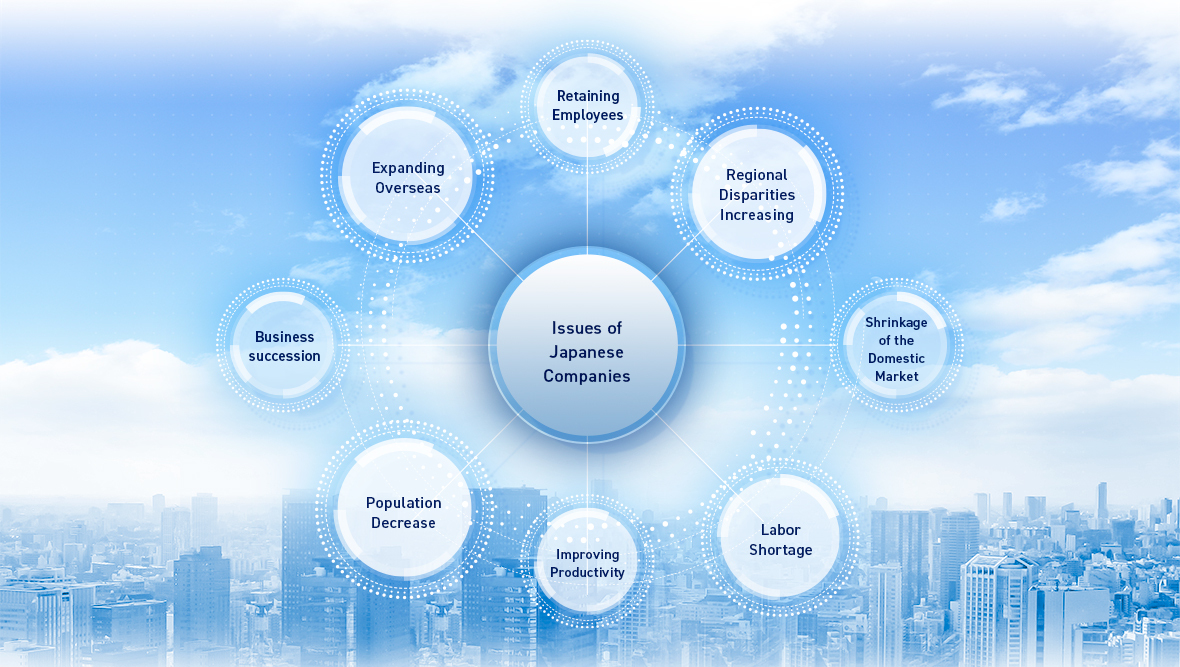
Since our founding, the Relo Group has continued to grow by supporting Japanese companies facing various issues.
The outsourcing service in the fringe benefit field that we provide at the Relo Group helps the employees of companies and their families improve their health, lifestyles, and welfare.
In addition, outsourcing services enable better workstyles by improving business efficiency and contribute to the conservation of energy and the reduction of labor by consolidating operations that exist within the individual companies.
Of the 17 SDGs, we focus on 10 goals that are directly related to the Relo Group's businesses.

The Relo Group has launched a large number of businesses to be a provider of solutions to the problems faced by the general affairs departments of Japanese companies.
Based on our mission, we will continue to provide services which will lead to solutions to the various issues faced by companies.
Our Mission
・To support the non-core operations of Japanese companies, enabling them to concentrate on their core operations and compete on the world stage
・To facilitate the global expansion of Japanese companies, empowering them to unleash their true potential
・To aid in the great transformation that awaits Japan
Solving Social Issues Through the Relo Group's Businesses
<Related SDGs>

FY2025/3
Membership: 11 million
Major companies have benefit programs which enable their employees to use luxury recreation facilities within tourist resorts, sports clubs, and other facilities. However, small- and medium-sized companies (SMEs), which far outnumber the major companies, did not have many benefits enriching the leisure time of their employees and their families. There was a substantial gap between major companies and SMEs.
Can we fill this gap? With this question in mind, we created Japan's first fringe benefit outsourcing service.
At present, we offer more than 100,000 options. They are not limited to common fringe benefits. We also suggest benefit programs needed by society, such as programs that support childcare and nursing care, promote health, or promote mental health care, thus solving fringe benefit issues.
We will continue to expand the fringe benefit programs that are available to the employees of our customer companies and their families that help them balance work and family life, and that support the personal development of employees.
Percentage of SMEs in Japan
Source: Chusho Kigyo Toha? Nippon Kigyo-no 99.7% (What are SMEs? They are 99.7% of Japanese Companies), Nihon Keizai Shimbun, May 20, 2020
<Related SDGs>
FY2025/3
Leased Corporate Housing Management :300,000 units
Employee benefits are attracting attention at a time when it is becoming increasingly important for companies to secure human resources amid the ongoing aging of the population.
On the other hand, people in charge of personnel and general affairs within companies are concerned about problems regarding housing-related fringe benefits.
It is of course costly to manage corporate housing. In addition, the workload placed on the people in charge of personnel and general affairs is heavy due to the cumbersome tasks necessary when an employee is transferred or relocates, and this causes serious problems.
In response, we realized a fully outsourced service managing leased corporate housing based on the first subletting scheme in the industry.
On behalf of our corporate customers, we handle matters related to lease contracts with the lessor and attend to employees who reside in the property.
Our support for a company's operations other than its main business enables the people in charge of personnel and general affairs to concentrate on their main businesses, leading to increased productivity.
Estimates and predictions on labor population
Source: Shoshi koureika-de rodoryoku jinko ha 4 wari gen (The Working Population Will Decrease by 40% Due to the Declining Birthrate and the Aging Population), Mizuho Research Institute, May 31, 2017
<Related SDGs>
FY2025/3
Global Relocation Support:10,000 households
An increasing number of companies are working to expand their businesses overseas because it is expected that the domestic market will shrink. This trend combined with government moves to support the overseas expansion of Japanese companies through various subsidy programs is accelerating the global expansion of Japanese companies.
However, global expansion involves the relocation of employees outside Japan, which involves more than 100 procedures per employee, including arranging visas, housing and children's schooling in the destination country, and vaccination before traveling to the country.
In more than a few cases, relocation does not go smoothly due to cumbersome procedures or a lack of information about the destination and in many cases employees and their families experience anxiety leaving Japan.
We confronted these issues that have been reported by people in charge of personnel and general affairs within companies. As a result, we created a service that enables the provision of comprehensive support before an employee is relocated, while they are working overseas, and when they are returning to Japan.
Instead of providing support only for relocation procedures, we have established a system that handles personal questions and anxieties, including providing information about the security of the destination country and information about shops which offer Japanese food.
We will continue to support people and companies working in many countries, thus contributing to the global expansion of Japanese companies.
Changes in the number of people living overseas long term
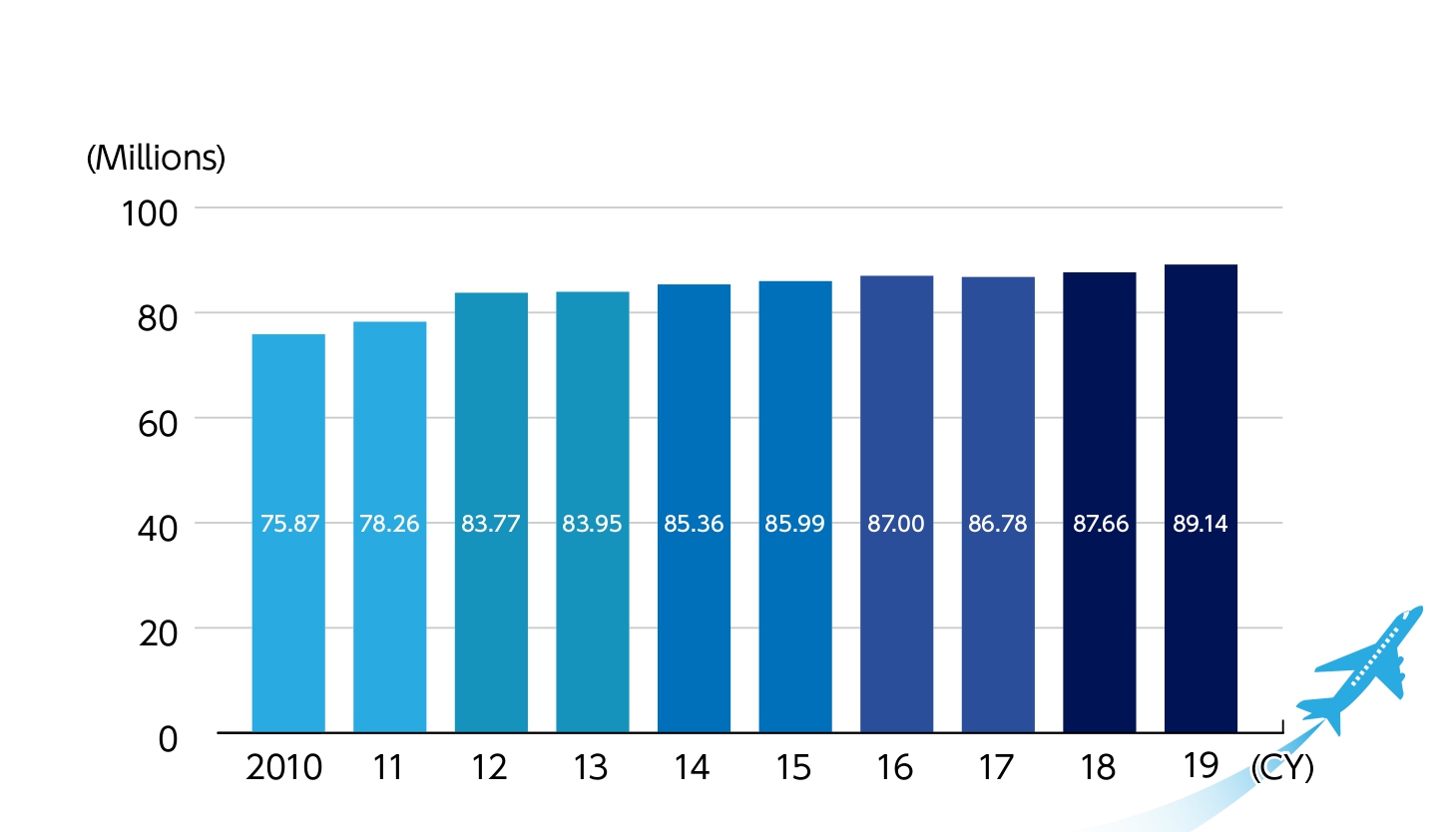
Source: Statistical Survey on Japanese Nationals Overseas, Ministry of Foreign Affairs, October 1, 2019
<Related SDGs>

These hotels and inns face many different problems, including a shortage of successors, aging facilities, poor readiness for information technologies and difficulties hiring and retaining human resources. They are obviously becoming less competitive due to lower profitability compared to large-scale facilities.The bankruptcy of a small- or medium-sized inn or hotel decreases the number of overnight accommodations and the attractiveness of tourist destinations. In addition, the young workforce seeking jobs will leave their region and move to more urban areas even though they are supposed to play key roles in regional economies. This accelerates the vicious cycle of depopulation.
We pay attention to these issues. Instead of development through new construction, we help facilities with many different problems so that they can achieve profitability and effectively use idle assets in an effort to increase the attractiveness of tourist destinations and prevent the young workforce from leaving. We have been working to resolve these regional issues.
We will continue to support projects rehabilitating resort hotels and inns leveraging our expertise in hotel operations and our Group's strengths.
<Related SDGs>

Small- and medium-sized businesses play an important role in supporting regional economies and employment. In recent years, some have been forced to close down despite profitability because of a lack of successors.It is estimated that a total of around 6.5 million jobs and approx. 22 trillion yen of GDP may be lost in the period up to 2025 if the current situation is not remedied.* The national government recognizes business succession as a social issue that must be quickly addressed, and is taking actions to address it. For example, the Ministry of Economy, Trade and Industry is actively encouraging mergers and acquisitions.
Since Tohto Co., Ltd. joined our Group as the first company acquired in an M&A deal in 2010, we have defined the rental management business as one of our strategic businesses. We have been expanding its business by continuously acquiring other rental management companies through M&A transactions.
Our basic M&A policy is to ensure that companies we acquire will maintain their names and structures centering on their current employees. We add our expertise and brand power to them to help them improve their service quality and work efficiency.
Our rental management business now operates not only in Tokyo and the surrounding suburban areas but also in Miyagi, Fukuoka, Osaka and other prefectures. More than 60 companies have joined our Group.We will continue to expand our business and help resolve the business succession problems faced by small and medium enterprises.
*The Small and Medium Enterprise Agency: Current State of M&A with Small and Medium Enterprises and Small Business Operators and Problems, November 7, 2019
Ages of managers of small and medium enterprises and small business operators in 2025*
Estimated based on the Ministry of Internal Affairs and Communications' Unincorporated Enterprise Survey FY2016 and Teikoku Databank, Ltd.'s company outline files in FY2016
<Related SDGs>
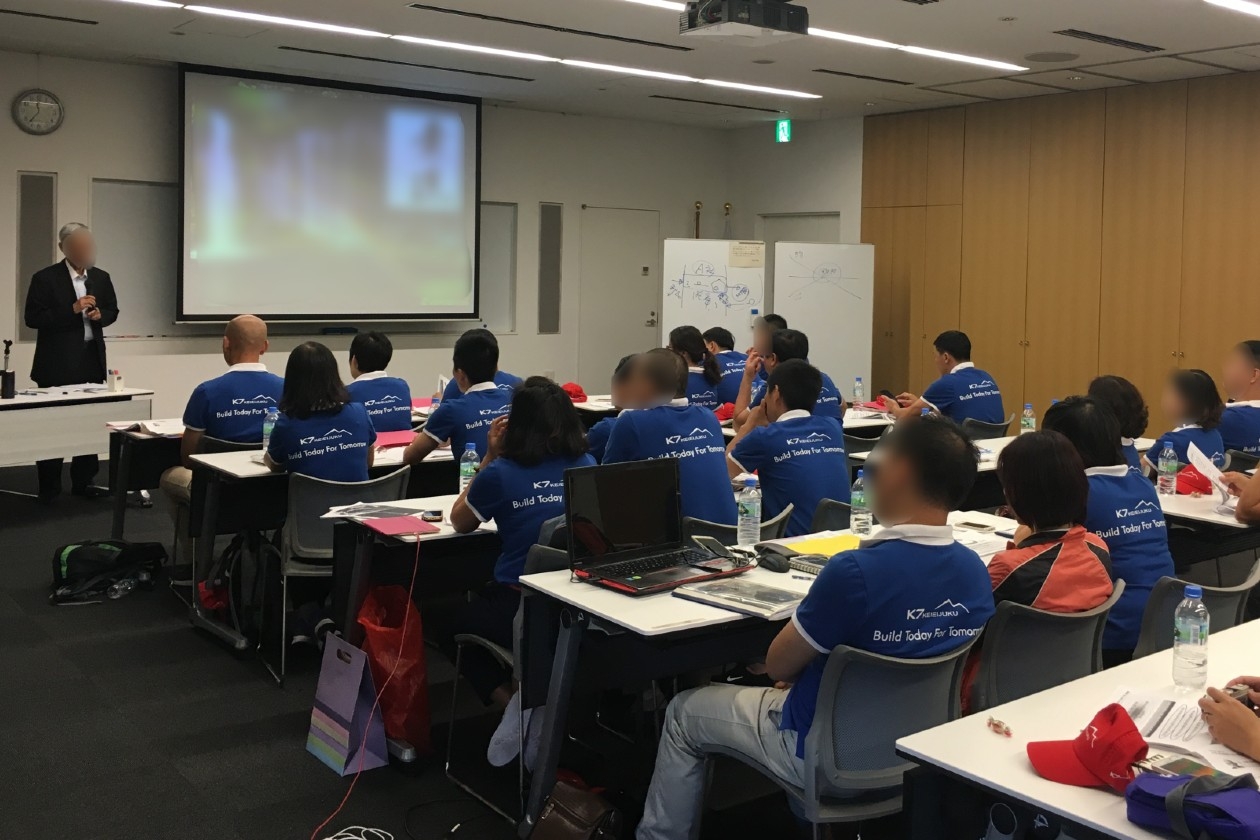
ReloExcel, Inc., a Relo Group company, is commissioned by the Japan International Cooperation Agency (JICA) to support the introduction and implementation of KEIEIJUKU management training programs for local business managers at Japan Centers* in Vietnam, Laos, Myanmar, Uzbekistan, the Kyrgyz Republic and other countries. Dispatching a large number of Japanese lecturers, we have been engaging in the project developing the people that will play central roles in the industry, include local business managers and executives.
Particularly in Vietnam, the company has been supporting the operations and management of the KEIEIJUKU program for more than a decade, since 2009. It has helped the country shift to a market economy.
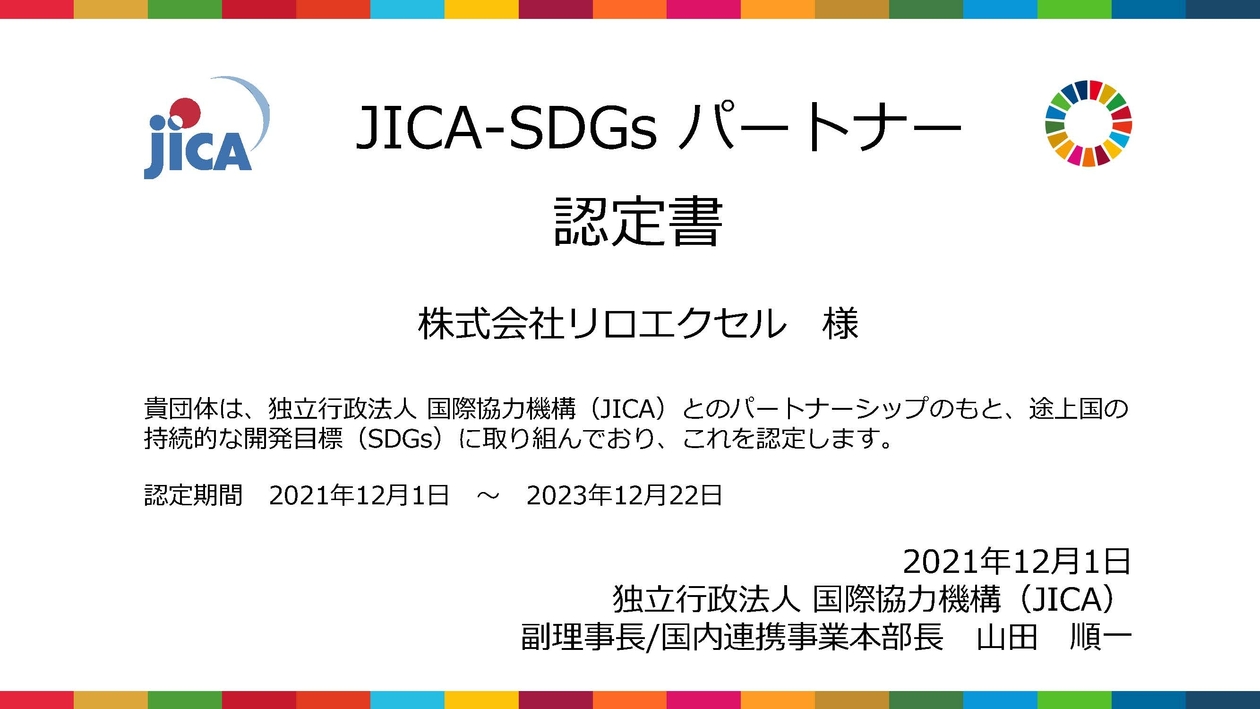
This activity was recognized as helping to achieve goal 8 (Promote sustained, inclusive and sustainable economic growth, full and productive employment and decent work for all) and goal 9 (Build resilient infrastructure, promote inclusive and sustainable industrialization and foster innovation) of the Sustainable Development Goals (SDGs), and ReloExcel, Inc. was certified as a JICA-SDGs partner in December 2021.We will carry out many different initiatives to help achieve the SDGs.
*Japan Centers are planned as bases for the development of business professionals and the creation of interpersonal networks with Japan as a part of JICA's "aid with a face" to countries shifting to a market economy.They have been opened in succession since 2000. There are now ten of these centers in nine countries in East Asia, Central Asia, Southeast Asia and elsewhere. They support the development of business professionals and the construction of networks that include local managers and Japanese companies.
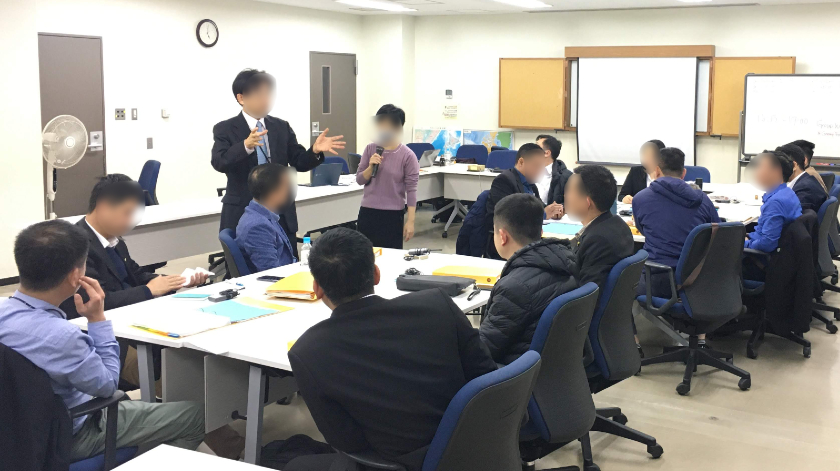
KEIEIJUKU training
*ReloExcel, Inc. is a subsidiary of Relo Group, Inc.
<Related SDGs>

Relo Club, Ltd., a Relo Group company, embarked on Fukuri Kosei Club services in 1993. It has since been supporting the lives of employees with welfare services and helping boost the vitality of these workers and their family members under the motto of offering welfare comparable with that for large companies to small and midsize businesses.
In the course of offering services, it received more and more inquiries from companies working on kenkokeiei® (health management). They sought specific measures for investing in health and, nowadays, solutions to new issues arising from longer working hours at home under the pandemic.
A food product company started tackling kenkokeiei as a new initiative after managing to reduce working hours through workstyle reforms. The initiative is aimed at boosting employees’ productivity and job satisfaction.
After several interviews, Relo Club found that the problem with the company was poor in-house recognition of kenkokeiei and that what was needed was to build up employees’ health literacy.
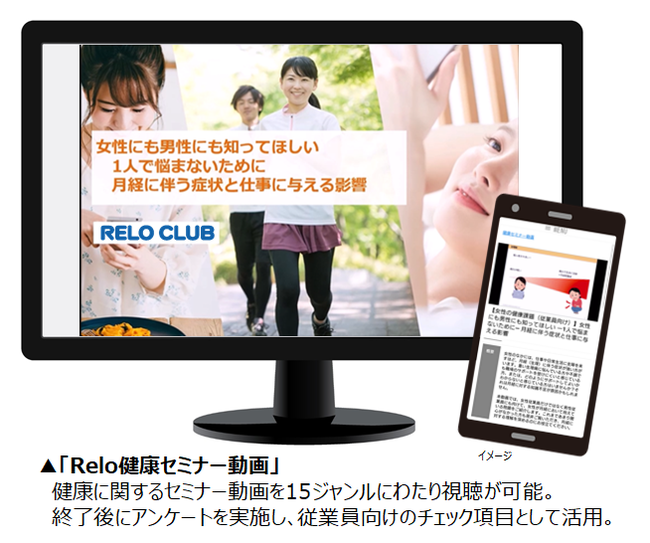
To address this problem, Relo Club created Relo Health Seminar Videos.
These are a set of videos separately designed for employees and for those in managerial positions. They cover 15 different subjects, such as women’s health issues, responses to older employees and sleep disorders. Using these videos, it is now possible to enhance staff’s understanding about health.
The videos have been well received, for several reasons. For example, they are appropriate to the current situation, where it is difficult to hold group training. They can be viewed by employees at overseas locations. And they deal with subjects that are associated with personal issues.
In addition, Relo Club created solutions for health maintenance and improvement activities, including the Relo Health Support App. It remotely encourages users to improve their health by addressing any lack of physical exercise or dietary issues during teleworking. It thus helps businesses and their employees with health management.
After these services were introduced to Relo Club itself, Relo Club has been recognized since 2022 under the Certified Health & Productivity Management Organizations Recognition Program in the large enterprise category. Its efforts to solve kenkokeiei problems in the corporate sector have earned high marks.
Relo Club will continue to serve enterprises in society and their employees in health development through various health-related business activities.
*The Japanese term kenkokeiei® (health management) is a registered trademark of Nonprofit Organization Kenkokeiei.
<Related SDGs>

The Relo Group has offices across Japan and their business is closely tied to the communities in which they are located.
The involvement of each business site and facility with the surrounding area enables them to coexist harmoniously with communities and contribute to their wellbeing.
- Disaster support
As a nationwide Tourism Business operator, RV believes that coexisting harmoniously with the communities in which it operates is essential to the growth of local tourism business.
During the torrential rain that struck western Japan in 2018, Hotel Kamogawaso in the city of Takehara in Hiroshima Prefecture did its utmost to assist by providing rescue workers with lodgings and the surrounding community with free access to its hot spring baths.
Other facilities are also actively engaged in support activities, such as making their facilities available to the general public in the event of a disaster and assisting evacuation centers.
- Participating in community cleanups
The Ekimae Real Estate Group, part of the Relo Group’s leasing management business, has assisted with disaster support efforts and organized volunteer activities. These activities are founded on an awareness of coexisting harmoniously with the community and consideration of the part each individual employee has to play in fostering that awareness.
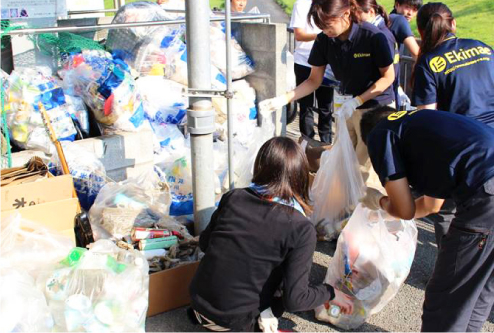
An example of the Group’s volunteer activities was its participation in the community cleanup, which entailed picking up litter after the summer matsuri festival and fireworks display to make the streets look clean and tidy.
(Reference URL:https://www.ekimae-r-e-holdings.co.jp/csr/volunteer/)
When the Atami landslide disaster occurred in 2021, the Group delivered 350 baked goods handmade by pastry chefs from our Tourism Business facilities to people sheltering in evacuation centers.
Employees of the Ekimae Real Estate Group leasing management business cleaning up the neighborhood.
<Related SDGs>

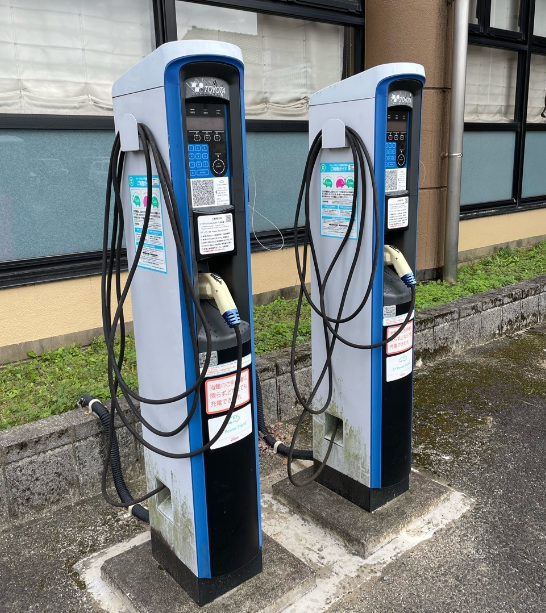
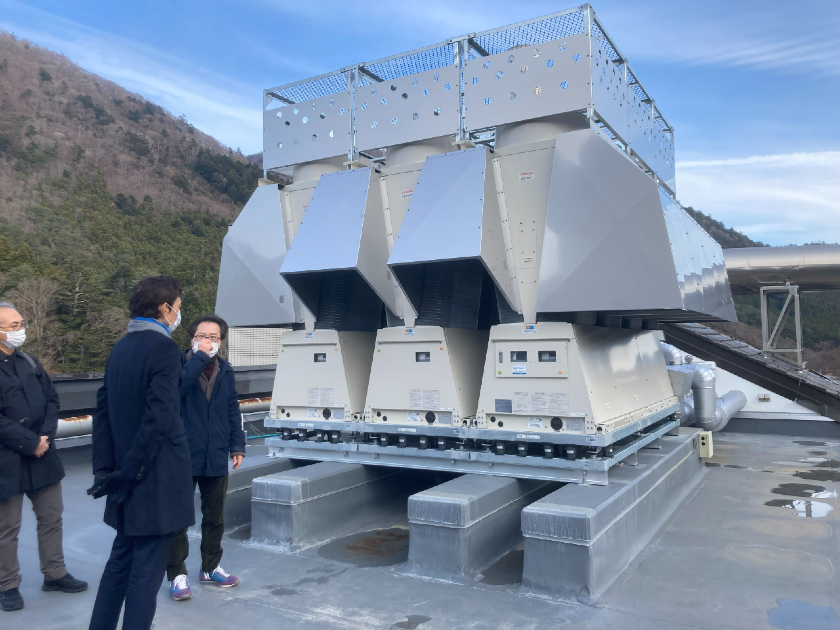
Installation of EV vehicle chargers at all hotel facilities that have parking lots by 2025 (photo shows chargers installed at Yutorelo Yamaga)
Relo Vacations (hereafter “RV”), a Relo Group company, operates the Tourism Business nationwide, including a membership resort business, and resort hotel and inn management revitalization business.
RV has been seeking to make efficient use of resources by renovating and rebranding disused lodging facilities and corporate recreation facilities. However, operating these facilities has brought with it issues such as waste products, food loss, and CO2 emissions.
To tackle these issues, an internal project team has been formed to strengthen SDG initiatives.
Click here to learn more about RV’s initiatives to seriously implement SDGs
Initiatives to eliminate heavy fuel oil use
Our hotel operation business facilities will gradually transition away from heavy fuel oil boilers toward equipment that has a low environmental impact by 2026, cutting CO2 emissions.
The installation of this equipment at Yutorelo Nasushiobara and Beppu Fuga in November 2021 has already resulted in a significant reduction in the ratio of heavy fuel oil consumption.
We plan to install similar equipment at five facilities in 2022: Oku Nikko Hotel Shikisai, Yutorelo Garden Kita-Karuizawa, Yumori Kamaya, Merveille Hakone Gora, and Hotel Kamogawaso.
Yutorelo Nasushiobara Heat Pump Facility

SDGs stand (Amenity Bar) installed at 25 facilities (as of September 20, 2022), mainly Yutorelo brand facilities
Initiatives to eliminate use of plastics
We are working to eliminate our use of plastics, setting a goal of 50% reduction in plastic use by 2025.
In an effort to reduce the amount of waste that contains plastic, we ask that guests bring their own toothbrush, razor, hairbrush, and other personal care items with them. If they forget to bring something, they are asked to use only the supplies they need.
The prosperity we aim for at the Relo Group is not temporary prosperity. We aim for sustainable prosperity, that is, we are a going concern.
This is because we believe that we cannot continue to provide services to customers without sustainable prosperity.
This is also because the continuity of the company is assumed by all stakeholders, not only our customers but also our investors, business partners, and employees.
At the Relo Group, we aim to prosper sustainably for 100, 200 and even 300 years.
Corporate Governance
Basic Policy on Corporate Governance
The Company's basic policy on corporate governance is to strive to continuously increase its corporate value by establishing a fair, highly transparent management system while considering the social responsibility of companies. Under this policy, the Company enhances its management monitoring functions while separating them from its business execution functions. This approach is the foundation of the Company's efforts to establish an effective governance system.
The Company positions its Board of Directors as the body that approves the Group's basic policies and monitors its execution of business. The Company strives to ensure prompt decision-making in the execution of business and to establish a system that enables improvement in the effectiveness of audits and supervision of the Audit and Supervisory Committee's decision-making.
Corporate Governance Report
Corporate Governance Structure

The Nomination and Compensation Advisory Committee
The Company has established the Nomination and Compensation Advisory Committee to be a non-statutory advisory body to the Board of Directors, with the aim of increasing the fairness, transparency, and objectiveness of procedures related to the nomination and remuneration of Directors and further enhancing corporate governance. In its advisory role to the Board of Directors, the committee deliberates on matters related to the nomination and remuneration of Directors and reports to the Board of Directors. The Nomination and Advisory Compensation Committee is composed of at least three members, including the Representative Director and CEO and Independent Outside Directors, with a majority of the members being Independent Outside Directors.
Composition of the Board of Directors
The composition of the Company's Board of Directors is as follows.
The attendance rate of each director is stated in the notice of annual general meeting of shareholders.General Meeting of Shareholders
| Number of Directors | 12 |
|---|---|
| Number of Independent Outside Directors included in the above | 4 |
Evaluation of the Effectiveness of the Board of Directors
The Company's Board of Directors began to conduct questionnaires to the directors and Company auditors in FY2017/3 to analyze and evaluate the effectiveness of the Board in terms of supervisory functions and appropriate decision-making regarding business execution.
As a result of the analysis and evaluation for FY2023/3, it was judged that the Board's composition and the topics it deliberates on and the Board's and Company auditors' business execution and effectiveness are generally appropriate and that the Board is functioning effectively in light of its roles and duties. Moving forward, we will leverage the aforementioned questionnaires and other opportunities in our efforts to further improve the effectiveness of the Board of Directors.
Status of Compliance Observance
The Relo Group has established compliance guidelines that apply to all officers and employees in Japan and overseas with the aim of maintaining fair relations with society and practicing behavior consistent with social ethics. It has prohibited all forms of corrupt practices, including not only the prevention of bribery of public officials but also the offering of entertainment, gifts, and any other form of benefit as well as the acceptance of personal benefits in violation of laws, regulations, and ethical standards.
With the belief that to fully enforce compliance and legal observance, it is imperative to establish a system and take action to raise the awareness of all officers and employees as well as to create a corporate culture conducive to implementing such measures, the Relo Group has established the Rules Regarding Administrative Authority and the Rules Regarding the Division of Duties, and thus has built a system enabling all employees, including directors and other officers, to execute business in compliance with laws, regulations, and rules.
In addition, the Relo Group has established the policies and measures described below to fully enforce the prevention of corrupt practices in a manner consistent with the current conditions of the times and has taken measures such as the establishment of a committee supervising the status of compliance and the establishment of guidelines based on the Rules for Compliance Management to enable all employees to ensure compliance as they forge ahead with operations.
Prevention of Transactions with Antisocial Forces
The Company has established its Basic Policy on Antisocial Forces and declared that it will not trade with or establish any relationships with antisocial forces.(Basic Policy on Antisocial Forces)
The Company and Group companies in Japan strive to collect information about new business partners before beginning transactions with them to investigate if they are considered antisocial forces.
In addition, the Company has instructed Group companies to include a clause on the elimination of antisocial forces in its contracts, so that they can immediately stop transactions with a business partner when the business partner is found to be an antisocial force after the beginning of transactions with that partner.
The Company has also established a workflow, in which questions arising about transactions are reported to the Legal Compliance Office. The Legal Compliance Office works together with external experts, including former police officers and lawyers, to handle the matters in question.
Establishment of Guidelines to Prevent Corrupt Practices
The Relo Group has honored the practice in the spirit of continuing to provide the best possible services to our customers in its principle. At the root of this principle lie compliance with laws and regulations as well as acts with ethical integrity to earn the trust and reputation of customers and society. We have established the Relo Group Compliance Guidelines as a code of conduct to be followed as a member of the Relo Group, so that we can continue contributing to society by solving the problems of as many customers as possible through compliance with laws and regulations and ethical and honest behavior in all of our corporate activities.
These Guidelines prohibit all forms of corrupt practices, including not only the prevention of bribery of public officials, but also the prohibition of entertainment and gifts, association with antisocial forces, provision of benefits in violation of laws and regulations or social ethics, and reception of personal benefits.
Basic Policy for the Prevention of Bribery
The Relo Group has formulated a basic policy to prevent bribery and has declared that it will never engage in any act that is or could be suspected of being bribery.(Basic Policy for the Prevention of Bribery.pdf)
To ensure the effective implementation of this basic policy, our Group has established an anti-bribery system which includes the Compliance Committee composed of directors of Relo Group, Inc. and members appointed by the Board of Directors of Relo Group, Inc. We also provide education and training to all of our officers.
We carry out many different actions to prevent bribery. They include periodical monitoring to check that the anti-bribery system functions and to encourage the improvement of operations.(Specific measures for effectively implementing Basic Policy for the Prevention of Bribery.pdf)
Compliance Training
The Company and Group companies in Japan provide all employees with e-learning training programs on compliance. Comprehensive compliance training is provided twice a year, and training on the protection of personal information is provided nine times a year. In addition, warnings are published on the internal intranet as appropriate, mainly regarding corporate scandals in the news, so that the same events do not occur within the Relo Group.
In addition to the above, initial compliance training is provided to new employees and training on the prevention of insider trading and on practical tasks regarding contracts are provided as appropriate.
Scope of Application of the Compliance Guidelines
The Company has established Compliance Guidelines, under which it provides not only Group companies in Japan but also overseas subsidiaries with thorough instructions to comply with laws, regulations, internal rules, and other rules in corporate activities and sales activities, through the Legal Compliance Office as the responsible department.
Internal Whistleblowing Hotline
The Company has established an internal whistleblowing system to accept employees' whistleblowing about internal acts in violation of laws, regulations, and rules.
The Company has established a system under which officers and employees who have found acts in violation of laws or regulations or any other acts of incompliance report them by following the compliance guidelines via a special hotline. Such acts are reported to the Legal Compliance Office, while acts of sexual or power harassment are reported to the Human Resource Development Office.
The department which has received the report is required to have the problem investigated and discussed by the Hotline System Committee and report the result to the whistleblower. In addition, people involved in the investigations have a confidentiality obligation to prevent disadvantages for the whistleblower.
External Whistleblowing Hotline
Our Group considers sound corporate management and the maintenance of social trust to be critical responsibilities in accordance with the Corporate Governance Code. As part of this commitment, we have established an "External Whistleblowing Hotline" managed by an independent specialized organization, in addition to our internal whistleblowing hotline.
This system is designed to receive reports and consultations regarding legal violations, misconduct, and compliance breaches while ensuring anonymity and impartiality. The information received will be utilized to thoroughly enforce corporate ethics through appropriate investigation and corrective action.
Relo Group External Whistleblowing Hotline: Kataoka & Kobayashi LPC
Attorneys in Charge: Hiroyuki Hasegawa, Kanako Maezawa, Manaka Watanabe
Phone: +81-3-3592-9151
Email: soudan_relogroup@klo.gr.jp
Hours: 10:00 AM - 6:00 PM (Monday - Friday, excluding public holidays)
For more information, please visit the link below. [Click here for details on the External Whistleblowing Hotline]
Response to Cases of Compliance Violations
The Company strives to ensure compliance with laws and regulations so that events involving illegal or unjust acts, which are subject to whistleblowing, will not occur. The Company has established and operates a whistleblowing system in case such an event occurs.
The department which has received a report is required to have the problem investigated and discussed by the Hotline System Committee.
The Company has also established a system to enable officers or employees who have uncovered an illegal act by another officer or employee to directly contact the Legal Compliance Office to report the act.
As of June 30, 2024, no such events have occurred. If one should occur, the Company will respond following the process as described above.
Information Security
1. Complying with laws and regulations relating to information security
We at the Relo Group are aware of the importance of information security and will develop and regularly revise our regulations, guidelines, and other rules to comply with all laws, regulations, and social norms related to our businesses.
2. Building an information security management system
To effectively and reliably implement, maintain, and improve information security measures in our operations, we will construct an appropriate information security management system and systematically collaborate with outside experts and information security management bodies.
3. Managing information assets
We will properly control the information assets we receive from customers and business partners to ensure their confidentiality, integrity, and availability and implement security measures to prevent them from being leaked, lost, or damaged.
4. Continuously improving information security measures
We are always aware of society’s need for new information security measures that are suited for changing statutory and regulatory requirements and for external threats such as cyberattacks. We will review different measures based on risk assessments to continuously improve our information security management system.
5. Providing information security training
To effectively and appropriately manage information security and implement other measures, we will regularly provide information security education to our officers and employees (including part-time workers, temporary workers, and the employees of our business partners) with a focus on maintaining and increasing their awareness.
Initiatives for the Effective Implementation of the Information Security Protection Policy
We understand that a very important obligation that we bear is ensuring that the information we possess, including information from customers, is protected and properly handled.
To comply with all laws, regulations, and social norms related to our businesses in accordance with our understanding of this obligation, we have established an information security management system. Under this system, the Management Advisory Council of Information Security (consisting of officers responsible for departments related to information security as well as presidents and other personnel from principal operating companies) deliberates issues, and the Group systematically collaborates with outside experts and information security management bodies to ensure the confidentiality, integrity, and availability of the information it possesses.
In addition, we regularly provide information security training to our officers and employees with a constant focus on maintaining and increasing their awareness to advance our information security management.(Specific measures for effectively implementing Information Security Protection Policy.pdf)
Rules and Practical Tasks Related to the Collection, Use, and Retention of Personal Information
(1)Principles regarding the collection of personal information
In the Rules Regarding the Protection of Personal Information, which apply across the Group, the Relo Group has stipulated the principle that the purposes of use shall be clearly shown to the person and their consent shall be obtained before collecting personal information, and it operates under these rules accordingly.
(2)Clarification of the purpose of use
The Relo Group announces the types of personal information that it collects and retains, the purposes of use of this information, and other details in the information about the handling of personal information published on each company's website and in other locations, etc. The Company has also stipulated in its rules that, where personal information is collected individually in writing or by other methods, the purpose of use of the information shall be explained as specifically as possible and the consent of the person whose information is being collected shall be obtained, and it operates under these rules accordingly.
(3)Prohibition of use for other purposes
The use of personal information indicated as above, and acquired for purposes other than those for which consent has been obtained as described is prohibited under the rules and the rules specify penalties for violations.
(4)Management of personal information
The Relo Group has created and manages the Personal Information Asset Management Ledger, in which information including the purposes of use, managers, and methods for the management of the collected personal information is summarized.
(5)Safety management measures for personal information
The Relo Group has established its Rules Regarding the Protection of Personal Information and Information Security Standards, which are common across the Group, and operates its safety management measures in accordance with them.The status of operations is regularly inspected by each company and audited by the Internal Audit Office of Relo Group, Inc. once a year.
Scope of Application of the Basic Personal Information Policy
The Company complies with laws, regulations, government guidelines, and other norms related to handling of personal information, has established common rules and bylaws for the Group companies in Japan based on the requirements of JIS Q 15001 (Personal Information Protection Management System) in its efforts to protect personal information, and strives to protect personal information accordingly.The privacy policy is summarized in the Group companies' Personal Information Protection Policy and Handling of Personal Information in line with the form of the individual Group company's business and published on their websites and in other locations.
The operating companies handling a significant amount of personal information, such as information about the employees of corporate customers and the customer information of member organizations, have obtained the Privacy Mark certification.(As of June 30, 2023, 9 companies have obtained the certification.)
Requesting the Disclosure, Correction, etc. of Personal Information and Specific Personal Information
The Company and the Relo Group have established Personal Information Consultation Desks within the individual companies, and information on these desks is disclosed on Group company websites and in other locations, etc. The Personal Information Consultation Desks disclose, correct, and delete personal information, stop the use or provision of the information, respond to related complaints and requests for consultation, and strive to resolve matters related to personal information.
Executive Organization in Charge of Personal Information
Legal Compliance Office
Training for the Protection of Personal Information
In addition to providing monthly information security training on the rules for business operations and operations security, the Company provides annual performance management system training aimed at the establishment of a management cycle.
Along with its provision of training, the Company takes measures such as recommending that employees take examinations for level 1 of the "Protection of Personal Information Certification" (Kojin Joho Hogo Jitsumu Kentei) to improve their knowledge and skills and increase their awareness of issues related to personal information.
Note: E-learning programs focused on personal information protection are intended for all Group employees (including officers, part-time employees, fixed-term employees, and contract employees). Each employee has taken one of these courses, including the paper-based makeup class.
| Number of employees who have received level 1of the "Protection of Personal Information Certification" (Kojin Joho Hogo Jitsumu Kentei) | 896 |
|---|
Status of Employees
Status of Employees
| Permanent employees | Temporary employees and the like | |
|---|---|---|
| FY2023 | 2,955 | 2,132 |
| FY2024 | 3,100 | 2,164 |
| FY2025 | 3,036 | 2,041 |
New-graduate Hires
We offer job opportunities to young job seekers every year.
| Male | 97 |
|---|---|
| Female | 101 |
Percentage of Mid-career Hires
| Number of employees (As of March 31, 2025) |
FY 2022/3 | FY 2023/3 | FY 2024/3 | FY 2025/3 | |
|---|---|---|---|---|---|
| Relo Partners, Limited | 1,653 | 76% | 53% | 56% | 62% |
| Relocation Japan, Limited | 1,007 | 71% | 68% | 58% | 64% |
| Relo Vacations, Limited | 1,104 | 60% | 69% | 68% | 54% |
| Relo Club, Limited | 463 | 68% | 83% | 82% | 81% |
Prohibition of Discrimination
We have formulated the Compliance Guidelines to push ahead with the creation of workplaces that are free of discrimination based on place of birth, nationality, race, faith, religion, gender, age, disability, academic background or any other reason, where a diverse workforce respects one another as partners and individuals are able to display their potential without stress or constraint.
To prevent harassment and similar behaviors we have established the Anti-Harassment Action Policy as a part of staff rules. Our Work Rules provide for disciplinary actions to be taken when a violation is uncovered.
In addition, we provide regular e-learning training programs focused on the prevention of sexual harassment and other gender discrimination and the prevention of abuse of authority to all personnel to provide fair and energetic workplaces.
Promotion of Diversity
The Relo Group and seven of its operating companies, Relo Club, Limited, Relocation Japan, Limited, Relo Create, Limited, Relo Vacations, Ltd., Relo Partners, Ltd., and Relocation International, Inc., which each employ over 101 people, have formulated action plans based on the Act on Promotion of Women's Participation and Advancement in the Workplace. They have taken steps to help working women balance work with their family lives, including revisions of childcare leave programs and programs enabling shorter working hours.
The percentage of women in positions that are at, above, or equivalent to the level of section manager are above the national average (calculated based on the percentage of women in positions at, above, or equivalent to the level of section manager, which is 12.3%, from the Basic Survey of Gender Equality in Employment Management for FY2024 by the Ministry of Health, Labour and Welfare).
| Ratio of male to female managers | Male: 76.9% |
|---|---|
| Female: 23.1% |
Initiatives Regarding Standards Related to the Labor Standards Act and Other Laws and Regulations
Preparations for the introduction of initiatives concerning, for example, revisions of laws regarding equal pay for equal work, have been made by holding briefings for all people in positions at the level of department manager or the equivalent within the Group, explaining to them the content of revisions, the Company's policies for responding to revisions, points that must be kept in mind, and other matters.In addition, differences in the content of operations, scope of responsibilities, and treatment of regular employees and non-permanent employees in all departments were identified, and reasons for these differences were analyzed. The results of this investigation enabled the Company to determine that there are presently no unreasonable differences in treatment of its employees. Of course, the treatment of employees will change if necessary in response to future changes in social situations or other changes.
Initiatives Supporting Childcare and Support Provided After Employees' Return to Work
When actively working employees leave the Relo Group because of the birth of a child, the Group loses a valuable resource. In addition, society has recognized the recent problem of the declining birthrate, and it is believed that the improvement of the childcare environment available to employees is a duty borne by companies.
The Company has established an environment that facilitates employees' ability to continue working. For example, employees who have fulfilled certain conditions are able to take advantage of programs enabling them to work shorter working hours after returning to work from childcare leave. The period for this has been extended from until the employee's child is three years old, which is required by law, to until the child starts school.
Also, we have announced the establishment of a consultation desk for childcare leave within the Group and formulated the Anti-Harassment Action Policy to ensure that no staff member is disadvantaged because of a pregnancy, the birth of a child, childcare or nursing care leave, or other reasons to establish fair, worker-friendly workplaces.
We take care of our employees and ensure that their work-life balance is considered. For example, people meeting all of the requirements below are entitled to extend the period for shortened working hours for childcare to a maximum of three years from the date when their child starts school.
(1)They have worked at the Group for three or more years.
(2)Their immediate manager has approved the extension.
| Number of employees who took childcare leave | 108 |
|---|---|
| Number of employees who used the shortened working hours program | 129 |
Labor Situation
- 1. Providing opportunities for diverse human resources to develop and play an active role
- The Group has set the idea of “management where employees are given a stage to demonstrate their abilities” and provides its employees with an environment that enables them to play an active role in many stages. We will develop and refine systems that focus on providing opportunities for personal growth and realization, such as a system to challenge new fields and realize career paths through open recruitment across a wide range of categories of business within the Group, and a career vision program that provides an opportunity once a year for employees to think about their career and share with their superiors the direction they seek to take.
- 2. Complying with various labor laws
- We will appropriately comply with working conditions related to working hours, vacations, holidays, minimum wages, etc., in accordance with local laws and regulations in the places where we do business.
- 3. Providing a safe and rewarding workplace environment
- In addition to proper management of working hours and holidays in accordance with laws and regulations and the payment of appropriate wages based on fair evaluation, we will strive to prevent harassment, ensure a safe work environment and support the promotion of mental and physical health, etc. We will also ensure fair treatment in the workplace based on the principle of equal pay for equal work.
- 4. Creating an environment for diverse work styles
- To respond to recent changes in the labor environment surrounding the Company, the Company believes it is necessary to establish a more comfortable work environment for its employees and advance initiatives such as enabling employees to flextime and to work staggered working hours.
Initiatives for Controlling and Reducing Working Hours and Improving Productivity
In accordance with labor legislation and labor-management agreements, including collective agreements, in different countries, we have established rules regarding working hours, break periods, overtime, days off work, leave and other matters in the Work Rules and the Pay Regulations.
In Japan, we have higher standards than prescribed by law. For instance, we pay premium wages for working hours in excess of 7.75 hours per day, our prescribed working hours.
We check and record the start and end times using time cards and computer use times. We give any employee working long hours access to industrial physicians so they can discuss their issues if any safety considerations are deemed necessary based on our standards. Thus, we are working on the management of employees' physical and mental health.
We are also engaged in many different initiatives aimed at reducing long working hours and enhancing productivity. They include IT investments to increase work efficiency and the introduction of programs enabling people to telework and commute outside of rush hours.
Wage Management and Pay System
Relo Group, Inc. and the Relo Group have formulated the Pay Regulations to provide for proper wages, commuting and other allowances, bonuses, extraordinary pay and retirement allowances in accordance with the Labor Standards Act. We have also introduced a performance-based pay program to increase our staff's skills and motivation. There does not exist salary disparity between men and women.
The Pay Regulations have provisions regarding minimum wages, statutory insurance benefits, off-hours work and other matters in compliance with all laws and regulations related to wages. We implement them to maintain and improve our staff's standard of living.
Starting salary of employees who were hired by the Relo Group as new graduates (monthly salary of people hired by the Group as a new graduate of a four-year university in April 2025): JPY 221,000 Percent of minimum wage: 120% (calculated based on the FY2024 revision of the Tokyo regional minimum wage of 1,163 yen by the Ministry of Health, Labour and Welfare)
Employee Stock Ownership Plan
Since its foundation, the Relo Group has promoted partnership management, under which all employees participate in management as people involved in the management of the company. It is recommended that employees be employees of their companies and also become involved in the management of the Company as shareholders and managers.
All employees, including contract employees, except employees in their probation period, are able to join the employee shareholding association.
Occupational Safety and Health
The Company and the Relo Group have discussed matters related to employee health and hygiene in their workplaces and established the Health Management Committee for the maintenance of good health, the prevention of occupational injuries, and other purposes.
The objectives of the Health Management Committee are to create a stress-free workplace environment, ensure that employees are able to maintain and improve their health and prevent diseases and injuries. It holds regular monthly meetings and shares the minutes of meetings with all staff members to disseminate important matters about industrial injuries and their health and hygiene.
We introduced the stress check program in fiscal 2016. Since then, we have been conducting a companywide stress check for the collective analysis of individual organizations within the company and the encouragement of health in the workplace.
The results of stress checks are used to help staff members realize their own stress statuses. They are also shared with the heads of departments and used to enable measures for the prevention of mental disorders.
People with long working hours and people for whom safety considerations are needed according to regular health checkup results are to be interviewed by an industrial physician in accordance with our standards. We then apply appropriate work-related measures and other actions to prevent the impairment of health.
We also have a dedicated helpdesk for employees to prevent and respond to mental and physical stress.
To prepare for a diverse array of emergency situations, we have established an emergency response policy and system and other basic matters in the Risk Management Regulations, the Disaster Control Measures Regulations and other related manuals.
| Permanent employees | Temporary employees and the like | Industrial injury rate | |
|---|---|---|---|
| FY2022 | 0 | 0 | 0% |
| FY2023 | 0 | 0 | 0% |
| FY2024 | 0 | 0 | 0% |
*Industrial injury rate = number of lost-time industrial injury victims / total working hours x one million hours
- Subjects: All operating companies based in Japan
- Period: From April 1, 2022 to March 31, 2024
Prevention of and Response to Harassment
Relo Group, Inc. and the Relo Group have formulated the Anti-Harassment Action Policy to prevent sexual harassment, the abuse of authority and other kinds of harassment related to pregnancy, childbirth, childcare and nursing care leave and other issues. We are ready to respond to any consultation regarding these issues.
When consulted, we are careful about the privacy of the people consulting us and respond carefully while examining their intention. Neither the people consulting us nor those involved in the checking of facts will be treated disadvantageously. If facts indicating harassment are confirmed, the internal Committee on Discipline will take strict disciplinary action.
In addition, to prevent recurrence, an internal notification is published to increase employee awareness, the incident is announced in an internal notice, and instructions regarding preventive measures are given, via the responsible people in the corporate planning office or other departments of subsidiaries.
Several instances of harassment are identified every year, and employees are strictly punished after the facts have been confirmed.
As part of initiatives for the prevention of harassment, the Company provides all employees with information about matters that are prohibited related to harassment, has established a consultation desk, and provides training and education to managers.
Policy on Customer Harassment
To consistently provide customers with high-quality services, the Relo Group has adopted a policy on customer harassment to ensure a safe and comfortable environment in which all stakeholders respect each other's human rights.
Employee Turnover Rate
| Voluntary retirement rate | 11.0% |
|---|
Calculation method: Number of employees who left during the current fiscal year ÷ number of employees
at the end of the previous fiscal year × 100
Status of Human Resources Development
The Relo Group sees the personnel sharing the dream and vision with its executives as partners and it considers the combination of all of their efforts for the realization of the dream and vision to be the core of its management. We call this partnership management.
To implement this partnership management, it is important that the partners that take part in management individually achieve growth. We have been working on personnel development based on the idea of management where employees are given a stage to demonstrate their abilities. Specifically, we give them opportunities at an early stage to experience responsibility for the implementation of business and operations in separate divisions realized through corporate growth. Our idea is to appoint them to take on these roles to encourage their growth and develop a large number of business managers.
Human Resource Development
Based on the concept of "management that gives opportunities," the Group actively promotes ambitious employees, regardless of gender, to management positions or higher positions at an early stage.
(1)Systems to Support Professional Growth
1) Training programs related to career paths
- Creation of a career vision and interviews with superiors for all employees
- Group training for current executives (360-degree feedback surveys)
- Group training for employees selected as executive candidates prior to promotion
2) Operational knowledge and skills training
These programs are conducted in the form of e-learning or group training depending on their content and nature.
- Fundamental and job-class-specific training: Training to understand our founding philosophy, new-graduate training, first-year training, new manager training, executive training, etc.
- Specific skill training: Training to improve specific business skills in specialized fields such as finance, legal affairs, and IT
- Compliance training: Training to enhance understanding and awareness of compliance matters including information security, personal information protection, and insider trading
3) Sharing of management philosophy with employees from companies with different cultures
Due to the increasing number of employees from companies with different cultures as a result of M&A, we will further enhance our training programs and initiatives to instill our management philosophy.
Training Programs in FY2025/3
(1) Total training hours: Approx. 94,397 hours
(2) Training hours per employee: Approx. 26 hours (= total training hours / number of trainees (3,544 in Japan))
(3) Breakdown by program
*Days and hours in the chart above indicate the average number of training days and hours per participant
| Training program | Days | Hours | Number of participants | |
|---|---|---|---|---|
| Job-class-specific training | Training for officers (e-learning) | - | 5 hours | 24 |
| Training for officers (group training) | 3 days | 15.5 hours | 11 | |
| Training for newly appointed Unit Managers (group training) | 1.5 days | 12 hours | 10 | |
| Training for newly appointed managers (group training) | 2 day | 14 hours | 99 | |
| Training for newly appointed managers (e-learning) | - | 1 hour | 131 | |
| Fundamental training | Training for new graduates in their third year | 1 day | 7.75 hours | 84 |
| Training for new graduates in their second year |
1.5 day |
9.5 hour | 83 | |
| Training for new graduates in their first year | 1 day | 7.75 hours | 117 | |
| Training for new employees | 5 days | 37 hours | 190 | |
| Training on the Company's founding philosophy (group training) | 0.5 day | 3.5 hours | 190 | |
| Training on the Company's founding philosophy (online) | - | 3 hours | 122 | |
| Global training | Training for overseas employees (HR Tech) | 5 days | 38.75 hours | 4 |
| Training for overseas employees (in Boston) | 6 days | 45.5 hours | 5 | |
| Awardee training | Training for annual award recipients | 1.5 days | 10 hours | 21 |
| New business planning and development training | First session | - | 1 hour | 74 |
| Second session | - | 1 hour | 73 | |
| Third session | - | 1 hour | 99 | |
| Compliance training | Information security: 7 sessions, compliance: 2 sessions, mental health: 2 sessions, harassment: 2 sessions, safe driving: 1 session, personal information protection: 1 session, insider trading: 1 session, infectious disease control: 1 session, safety confirmation training: 1 session, health management: 2 sessions, disaster prevention training: 2 sessions, special labor training: 1 session | - | 23 hours | 3,544 |
(2) System to Help Employees Take On Challenges
Underscoring the importance of management that gives opportunities, the Group has implemented an intra group job posting system to provide ambitious individuals with opportunities for further advancement. We support transfers to other Group companies for regular employees who, at the time of the ransfer, will have been with the Company for at least two years since their last transfer or since joining the Company.
| Number of employees who have transferred through the intra group job posting system |
11 |
|---|
Human Rights
Basic Policy on Human Rights
The Relo Group understands that respect for human rights is key to realizing sustainable local communities. Accordingly, we support and respect international human rights standards, such as the International Bill of Human Rights, the United Nations Guiding Principles on Business and Human Rights, the ILO Declaration on Fundamental Principles and Rights at Work, and the Children's Rights and Business Principles, and carry out business operations in accordance with them.(Basic Policy on Human Rights)
Diversity and Inclusion
Diversity and Inclusion Efforts
The Relo Group is aware that diversity and inclusion is an important management issue, and its goal is to serve customers and local communities by ensuring that its employees with diverse values and characteristics respect and help each other develop in accordance with the Group's Sustainability Policy.
We will work to build a workplace environment and culture where all personnel who are diverse in terms of their gender, age, nationality, race, ethnicity, faith, social status, disability, sexual orientation, gender identity, values, workstyle, and other characteristics will respect and understand one another and display their potential and achieve growth together. (Diversity & Inclusion Efforts)
Environment
Our Policy Related to Climate Change
We have identified "Contribute to resolving social and environmental issues" as one of the material issues necessary for value creation. We promote initiatives on a daily basis, including those aimed at reducing our environmental impact.
We will work to improve our disclosure of climate change-related information in accordance with the Task Force on Climate-related Financial Disclosures (TCFD) recommendations.
TCFD Recommendations
The TCFD recommends that companies disclose information related to climate-related risks and opportunities in the four areas of (1) governance, (2) strategy, (3) risk management and (4) metrics and targets.
We disclose climate-related information related to these four recommended areas.
| item | Outline | |
|---|---|---|
| (1)Governance |
The organization's governance around climate-related risks and opportunities |
|
| (2)Strategy |
The actual and potential impact of climate-related risks and opportunities on the organization's businesses, strategy and financial planning |
|
| (3)Risk Management |
The processes used by the organization to identify, assess and manage climate-related risks |
|
| (4)Metrics and Targets |
The metrics and targets used to assess and manage relevant climate-related risks and opportunities |
|
(1)Governance
In May 2023, the Relo Group set up a Sustainability Committee chaired by the representative director and CEO of the Company with a view to strengthening its sustainability efforts. This committee monitors the activities of individual Group companies to respond to risks and opportunities, including those involving climate change, and addresses and discusses these issues in order to accelerate sustainability-related actions.
The Board of Directors receives at least one report on sustainability actions each year from the Sustainability Committee, which it uses to monitor and supervise activities for tackling issues and responses to risks and opportunities. These actions constitute the Relo Group's governance structure
(2)Strategy
We predicted changes that will have occurred in the external environment in 2030 and conducted scenario analysis to analyze the impact of climate change on our businesses in accordance with the TCFD framework.
Scope of analysis
The scope of the analysis included the Fringe Benefit Business, the Leased Corporate Housing Management Business, the Global Relocation Support Business, the Residential Property Management Business and the Tourism Business.
Identification of risks and opportunities
We identified climate change risks and opportunities for our businesses. From among them, we selected items that are highly relevant to our businesses.
Assumed scenarios
We assumed a 1.5°C scenario and a 4°C scenario, considering parameters and societal changes while referencing relevant scenarios disclosed by various governmental organizations.
| Scenario | Outline | Key references |
|---|---|---|
| 1.5°C scenario |
|
|
| 4°C scenario |
|
|
<The Fringe Benefit Business>
Risks, opportunities and evaluation: 1.5 °C scenario
In the 1.5 °C scenario, the following risks and opportunities were identified as having a great impact on the Fringe Benefit Business and a high probability of occurrence.
| Category | Item | Potential financial impact | Impact on us | ||
|---|---|---|---|---|---|
| Risk | Transition risks | Policy and regulatory risks | Rising cost of GHG emissions | Increase in operating costs (pressure on operating profit) | Increased operating costs due to the introduction of a carbon tax |
| Strengthening of emission reporting obligations | Increase in administrative costs (pressure on operating profit) | Each sales office is compelled to calculate greenhouse gas emissions | |||
| Reputational risks | Change in consumer preferences | Decrease of revenue resulting from a decrease of demand for products and services | If we remain passive in our climate change response, our major corporate customers will cease to select us as their outsourcing partner | ||
| Opportunities | Technology and market | Introduction of new technology | Increasing returns from investments in low-emission technologies | Increase in revenue from products and services with lower emissions | As systemization advances, operational costs decrease and associated labor costs are reduced, leading to increased profits |
| Products and services | Consumer attitudes | Change in consumer preferences | Reputational benefits which lead to increased demand for products and services | Increased demand for non-statutory employee benefits driven by further inflation will boost profits | |
| Enhancing reputation and increasing revenue through the development of environmentally responsive products and services | |||||
<The Fringe Benefit Business>
Risks, opportunities and evaluation: 4 °C scenario
In the 4 °C scenario, the following risks and opportunities were identified as having a great impact on the Fringe Benefit Business and a high probability of occurrence.
| Category | Item | Potential financial impact | Impact on us | ||
|---|---|---|---|---|---|
| Risk | Transition risks | Market risks | Changes in customers' behaviors | Decrease of revenue resulting from a decrease of demand for products and services | The likelihood of cancellations increases due to reduced usage caused by extreme heat and decreased outings |
| Rising raw material costs | Increase in operating costs (pressure on operating profit) | As raw material costs rise, if the discount rate offered by suppliers (service providers) decreases, the cost burden to maintain the discount rate increases | |||
| Opportunities | Resource efficiency | Transportation and SC | Use of more efficient transportation (modal shift) | Reduction of operating costs (for example, the improvement of efficiency and cost reduction) | Labor will no longer be necessary due to progress in prefabricated construction, which will reduce personnel expenses |
| Products and services | Consumer attitudes | Changes in consumer preferences | Increase in revenue resulting from enhanced competitiveness reflecting changing consumer preferences | Emergence of products and menus with increased appeal and new demand driven by climate change | |
<The Fringe Benefit Business>
Evaluation of the impact of risks and opportunities on CF and countermeasures
The financial impact of various risks and opportunities was estimated as follows. The impact is minor on the whole, and we will take appropriate measures in response to these matters.
| Item | Financial impact | Assessment of impact in 2030 | Level of impact* | Our response | |
|---|---|---|---|---|---|
| 1.5°C scenario | Risk | Increased operating costs due to the introduction of a carbon tax | A 140 USD/t-CO2 carbon price will be introduced | ー | We will promote decarbonization and energy-saving measures |
| Risk | Increased disclosure costs due to stricter regulations | Increase in administrative costs arising from enhanced investor and sustainability disclosures and stakeholder communication | ー | The expenses are necessary, so we will carefully take measures by securing the necessary workforce | |
| Risk | Customer churn and decline in sales due to delays in environmental compliance | Responding to customer needs through service provision and information dissemination requires time, and there is a risk of customer attrition if reputation is damaged | ーー | We will launch a service which will cater to customer needs and publicize our initiatives by carefully providing information, IR activities, etc. | |
| Opportunities | Increased sales through the provision of environmentally conscious service menus | Providing services that meet customers' environmental needs is expected to increase customer satisfaction and value, leading to customer growth | ++ | Establish a framework to provide services that meet new needs while capturing opportunities through sales activities | |
| Opportunities | Appropriate environmental measures lead to customer acquisition and increased sales revenue. | Appropriate responses and service provision aligned with customer needs create opportunities for revenue generation | ++ | Capture opportunities by explaining services tailored to customer needs and delivering thoughtful information within sales activities | |
| 4℃ scenario | Risk | Decrease in sales due to lower utilization rates | There is a risk that government-mandated stay-at-home orders and work-from-home initiatives could reduce demand for employee benefits | ー | Implement measures such as introducing services that address new needs and strengthening sales activities |
| Risk | Increased costs due to our company compensating for the sharp rise in product unit prices | When suppliers' costs increase due to rising purchase prices, there is a risk that our company will have to compensate to maintain the discount rates on listed products at their previous levels | ー | Reviewing listed products and price pass-through | |
| Opportunities | Increased sales due to rising demand for discounts caused by soaring product unit prices | With rising prices in the market, an opportunity is anticipated for increased demand for discounts among our members | ++ | We will develop a system to provide services catering to customer needs and acquire opportunities through sales activities | |
| Opportunities | Increased sales due to rising demand for menu items | The decrease in summer outings is expected to increase demand for fall and winter menus, leading to an increase in customers | + | Establish a framework to provide services that address transformed and emerging needs, while capturing opportunities through sales activities | |
| Opportunities | Increase in sales through partnerships with new businesses | Reduced outings are expected to lead to new revenue streams through partnerships with other businesses and expansion into new ventures | + | Capture opportunities by launching new businesses and services that add value in response to emerging needs, and by conducting sales activities | |
| Opportunities | Increase in sales due to expanding demand for employee benefits | As remote work increases, securing talent becomes more difficult due to rising domestic and international relocation, intensifying competition for personnel and expanding the importance of employee benefits programs | + | Establish a framework to provide services that address emerging needs as added value, while capturing opportunities through sales activities |
|
| Opportunities | Increased sales due to rising demand for cashless payments | If reduced outings drive increased demand for cashless payments, demand for employee benefits programs (Club Off) will grow as an added value of cashless functionality | + | ||
<The Leased Corporate Housing Management Business>
Risks, opportunities and evaluation: 1.5 °C scenario
In the 1.5 °C scenario, the following risks and opportunities were identified as having a great impact on the Leased Corporate Housing Management Business and a high probability of occurrence.
| Category | Item | Potential financial impact | Impact on us | ||
|---|---|---|---|---|---|
| Risk | Transition risks | Policy and regulatory risks | Rising cost of GHG emissions | Increase in operating costs (pressure on operating profit) | Costs will increase due to an increase in carbon tax rates and the expansion of the carbon cap and trade system (For example, there will be additional expenses in relation to some of the CO2 emissions of the supply chain.) |
| Technological risks | Replacement of existing products and services with low-emission products and services |
Decline in profit resulting from decrease in demand associated with transition to low-emission products and services | If properties meeting customers' needs regarding environmental onsiderations, such as ZEH condominiums, are in short supply, the property brokerage service (RELONET)'s contract ratio will fall | ||
| Market risks | Changes in customers' behaviors | Decrease of demand for products and services (decrease of sales) resulting from changes in consumer preferences | If properties meeting customers' needs regarding environmental considerations, such as ZEH condominiums, are in short supply, the property brokerage service (RELONET)'s contract ratio will fall | ||
| Reputational risks | Change in consumer preferences | Decrease of revenue resulting from a decrease of demand for products and services | If we remain passive in our climate change response, our major corporate customers will cease to select us as their outsourcing partner | ||
| Opportunities | Energy sources | Energy sources | Conversion to distributed energy sources | Reputational benefits which lead to increased demand for products and services |
Commission income will increase due to the installation of power generation equipment or EV charging equipment installed using stalls, such as car parking spaces at condominiums |
| Products and services | Service development | Development/expansion of the business domains of low-emission products and services |
Increase in revenue from products and services with lower emissions | If there is a sufficient supply of properties meeting customers' needs regarding environmental considerations, such as ZEH condominiums, the property brokerage service (RELONET)'s contract ratio will rise | |
| Use of the property brokerage service (RELONET) will increase due to the development a system that visualizes CO2 emissions from moving companies or enables users to specify ZEH condominiums as the places they wish to move into, for example | |||||
| Orders received for construction, including remodeling to increase energy conservation, will increase | |||||
<The Leased Corporate Housing Management Business>
Risks, opportunities and evaluation: 4 °C scenario
In the 4 °C scenario, the following risks and opportunities were identified as having a great impact on the Leased Corporate Housing Management Business and a high probability of occurrence.
| Category | Item | Potential financial impact | Impact on us | ||
|---|---|---|---|---|---|
| Risk | Physical risks | Acute | Increase of the severity of extreme weather events such as typhoons and floods |
Decrease of profit due to the suspension of business due to transportation difficulties of supply chain disruptions | The corporate housing system will cease to operate and damage to business sites, communications equipment and other assets will increase |
| Actions will need to be taken if occupied properties are affected | |||||
| Opportunities | Resource efficiency | Transportation and SC | Use of more efficient transportation (modal shift) | Reduction of operating costs (for example, the improvement of efficiency and cost reduction) | Labor will no longer be necessary due to progress in prefabricated construction, which will reduce personnel expenses |
| There will be an increase in the use of corporate housing as a fringe benefit aimed at securing a workforce Use of our outsourcing services will also increase |
|||||
| Resilience | Substitution/diversification of resources | Revenue will increase due to new products and services related to measures to increase resilience | Orders received for construction, including remodeling to increase energy conservation, will increase | ||
<The Leased Corporate Housing Management Business>
Evaluation of the impact of risks and opportunities on CF and countermeasures
The financial impact of various risks and opportunities was estimated as follows. The impact is minor on the whole, and we will take appropriate measures in response to these matters.
| Item | Financial impact | Assessment of impact in 2030 | Level of impact* | Our response | |
|---|---|---|---|---|---|
| 1.5°C scenario | Risk | Introduction of carbon pricing | A 140 USD/t-CO2 carbon price will be introduced | ー | We will promote decarbonization and energy-saving measures |
| Risk | Increased disclosure costs due to stricter regulations | Increase in administrative costs arising from enhanced investor and sustainability disclosures and stakeholder communication | ー | The expenses are necessary, so we will carefully take measures by securing the necessary workforce | |
| Risk | Decrease of our market share as a result of a competitor's launch of an environmentally friendly service | There is the risk that our market share will decrease if a competitor develops and launches a service that caters to the environmental needs of customers | ーー | We will launch a service which will cater to new needs and publicize our initiatives by carefully providing information, IR activities, etc. | |
| Opportunities | Increase in orders for remodeling/renovation | Orders related to remodeling/renovation will increase if the need to convert building into environmentally friendly housing /corporate housing increases | + | We will develop a system to provide services catering to customer needs and acquire opportunities through sales activities | |
| Opportunities | Popularization of new services for owners (EV) | There will be opportunities to provide new services, such as the brokering of the installation of EV charging equipment, because real estate owners' need to improve the environmental performance of owned properties, etc. will increase | + | We will take advantage of business opportunities by launching services which cater to new needs and carrying out sales activities | |
| Opportunities | Popularization of new functions for corporate customers (RELONET) | There will be opportunities to provide services catering to new needs (such as the brokering of environmentally friendly properties and the visualization of CO2 emissions associated with people relocating for work) because corporate customers need to take environmental measures will increase | + | ||
| 4℃ scenario | Risk | Decrease of our market share as a result of a competitor's launch of an environmentally friendly service | There is the risk that our market share will decrease if a competitor develops and launches a service that caters to the environmental needs of customers | ー | We will launch a service which will cater to new needs and publicize our initiatives by carefully providing information, IR activities, etc. |
| Risk | Increase of administrative expenses resulting from an increase in the number of disasters | There is the risk that the cost of responding to emergencies will increase due to an increase in flood damage and other disasters that devastate properties | ー | We will implement measures, such as increasing the efficiency of business and DX to prepare for the risk of an increase in administrative duties | |
| Risk | Increase in the cost of recovery and damages, etc. resulting from damage to offices and data centers | We may incur expenses related to restoration efforts, the suspension of business or delayed remittances for corporate housing management, etc. due offices or data centers being damaged in a disaster | ー | We will implement measures to increase our disaster resilience, such as the formulation of a BCP and thoroughly informing employees of the BCP | |
| Opportunities | Increase in orders for remodeling/renovation | Orders related to remodeling and renovation will increase reflecting the growing need for corporate customers and owners to transition to disaster-resilient housing | + | We will develop a system to provide services catering to customer needs and acquire opportunities through sales activities | |
| Opportunities | Increase in the use of corporate housing reflecting demand for fringe benefits | It is expected that opportunities will increase in relation to the use of corporate housing as a fringe benefit in industries facing a labor shortage due to the worsening labor environment | + | ||
| Opportunities | Increasing market share by catering to new needs | There will be opportunities to generate revenue as a result of the introduction of services catering to new needs, such as the provision of property search services linked to hazard maps |
+ | We will take advantage of business opportunities by launching services which cater to new needs and carrying out sales activities |
|
- :Negative financial impact less than 300 million yen
-- :Negative financial impact between 300 million yen and 600 million yen
---:Negative financial impact of 600 million yen or more
+ :Positive financial impact less than 300 million yen
++ :Positive financial impact between 300 million yen and 600 million yen
+++:Positive financial impact of 600 million yen or more
<The Global Relocation Support Business>
Risks, opportunities and evaluation: 1.5 °C scenario
In the 1.5 °C scenario, the following risks and opportunities were identified as having a great impact on the Global Relocation Support Business and a high probability of occurrence.
| Category | Item | Potential financial impact | Impact on us | ||
|---|---|---|---|---|---|
| Risk | Transition risks | Policy and regulatory risks | Rising cost of GHG emissions | Increase in operating costs (pressure on operating profit) | Increased operating costs due to the introduction of a carbon tax |
| Increased costs due to rising utility (water, electricity, gas) and gasoline prices | |||||
| Strengthening of emission reporting obligations | Increase in administrative costs (pressure on operating profit) | Each sales office is compelled to calculate greenhouse gas emissions | |||
| Market risks | Changes in customers' behaviors | Decrease of revenue resulting from a decrease of demand for products and services | As online services expand, the use of airplanes and trains decreases, leading to fewer opportunities for arrangement services and reduced volumes of goods transported during moves, resulting in decreased revenue | ||
| Rising raw material costs | Rapid increase and unexpected change in energy costs | The decline in business travel due to soaring airfares leads to a decrease in revenue | |||
| Reputational risks | Changes in consumer preferences | Decrease of demand for products and services (decrease of sales) resulting from changes in consumer preferences | Social resistance to using greenhouse gas-emitting transportation such as airplanes, trains, and cars is growing, leading to declining demand and reduced revenue | ||
| Opportunities | Market risks | Access to new markets | Increase in revenue from products and services with lower emissions | Enhancing reputation and increasing revenue by providing environmentally friendly products and services during moves and transfers | |
<The Global Relocation Support Business>
Risks, opportunities and evaluation: 4 °C scenario
In the 4°C scenario, the following risks and opportunities were identified as having a great impact on the Global Relocation Support Business and a high probability of occurrence.
| Category | Item | Potential financial impact | Impact on us | ||
|---|---|---|---|---|---|
| Risk | Transition riskss | Market risks | Rising raw material costs | Rapid increase and unexpected change in energy costs | The decline in business travel due to soaring airfares leads to a decrease in revenue. |
| Reputational risks | Changes in consumer preferences | Decrease of demand for products and services (decrease of sales) resulting from changes in consumer preferences | Social resistance to using greenhouse gas-emitting transportation such as airplanes, trains, and cars is growing, leading to declining demand and reduced revenue. | ||
| Physical risks | Acute | Increase of the severity of extreme weather events such as typhoons and floods | Decrease of profit due to transportation difficulties or supply chain disruptions | Increased natural disasters at business trip or assignment locations may lead to reduced profits. | |
| The possibility of increased accidents/cancellations on planes, trains, etc., due to disasters or adverse weather conditions. | |||||
| Opportunities | Market | Access to new markets | Increased in revenue through new products and services related to ensuring resilience | Development of a new assignment support service to address abnormal weather conditions occurring at assignment locations | |
<The Global Relocation Support Business>
Evaluation of the impact of risks and opportunities on CF and countermeasures
The financial impact of various risks and opportunities was estimated as follows. We will implement appropriate environmental measures for accommodation facilities in our efforts to reduce risk.
| Item | Financial impact | Assessment of impact in 2030 | Level of impact* | Our response | |
|---|---|---|---|---|---|
| 1.5°C scenario | Risk | Increased operating costs due to the introduction of a carbon tax | A 140 USD/t-CO2 carbon price will be introduced | - | We will promote decarbonization and energy-saving measures |
| Risk | Increased disclosure costs due to stricter regulations | Increase in administrative costs arising from enhanced investor and sustainability disclosures and stakeholder communication | - | The expenses are necessary, so we will carefully take measures by securing the necessary workforce | |
| Risk | Decrease in service demand due to increased transportation costs associated with environmental compliance | At client companies, the growing necessity for environmental measures and increased travel costs pose a risk of reduced opportunities for business trip support | - | We will launch a service which will cater to new needs and publicize our initiatives by carefully providing information, IR activities, etc. | |
| Risk | Declining service demand due to the spread of remote work and avoidance of environmentally harmful commuting | ||||
| Opportunities |
Revenue growth through new service additions | The introduction of services addressing new needs, such as visualizing CO2 emissions associated with business trips and assignments through system development, creates opportunities for revenue generation | + | We will take advantage of business opportunities by launching services which cater to new needs and carrying out sales activities | |
| 4°C scenario | Risk | Decrease in service demand due to increased transportation costs associated with capital investments in aircraft and other equipment | Increased travel costs pose the risk of reduced business travel opportunities as client companies seek to cut expenses | - | We will launch a service which will cater to new needs and publicize our initiatives by carefully providing information, IR activities, etc. |
| Risk | Increased administrative costs due to a rise in flight cancellations and other disruptions | With the increase in typhoon damage and other incidents, there is a risk that emergency response costs will rise due to cancellations of air and sea shipments | - | We will implement measures, such as increasing the efficiency of business and DX to prepare for the risk of an increase in administrative duties | |
| Risk | Decrease in business travel opportunities due to increased risks of flight cancellations and accidents | With the increase in typhoon damage and other disasters, the promotion of remote work at client companies poses the risk of reduced opportunities for business trip support | - | We will develop a system to provide services catering to customer needs and acquire opportunities through sales activities | |
| Opportunities | Increased outsourcing demand due to rising administrative costs | The increasing complexity of business trip and assignment arrangements makes it difficult for client companies to handle these tasks in-house, creating opportunities for increased utilization of our outsourcing services | + | We will take advantage of business opportunities by launching services which cater to new needs and carrying out sales activities | |
<The Residential Property Management Business>
Risks, opportunities and evaluation: 1.5 °C scenario
In the 1.5 °C scenario, the following risks and opportunities were identified as having a great impact on the Residential Property Management Business and a high probability of occurrence.
| Category | Item | Potential financial impact | Impact on us | ||
|---|---|---|---|---|---|
| Risk | Transition risks | Policy and regulatory risks | Rising cost of GHG emissions | Increase in operating costs (pressure on operating profit) | Increased operating costs due to the introduction of a carbon tax |
| Increased costs due to mandatory EV transition and other measures | |||||
| Increased costs due to rising utility (water, electricity, gas) and gasoline prices | |||||
| Strengthening of emission reporting obligations | Increase in administrative costs (pressure on operating profit) | Each sales office is compelled to calculate greenhouse gas emissions from its operations and company vehicles | |||
| Market risks | Changes in customers' behaviors | Decrease of demand for products and services (decrease of sales) resulting from changes in consumer preferences | Decreased sales because managed/brokerage properties are not environmentally compliant, leading to customers not choosing them | ||
| Rising raw material costs | Rapid increase and unexpected change in energy costs | Increased costs due to rising utility (water, electricity, gas) and gasoline prices | |||
| If cost increases cannot be passed on to prices in a timely manner, gross profit may decrease | |||||
| Reputational risks | Change in consumer preferences | Decrease of revenue resulting from a decrease of demand for products and services | There is a possibility that revenue will decrease if the popularity of environmentally compliant rental and sales properties increases but demand cannot be met | ||
| Opportunities | Asset efficiency | Promotion of 3Rs | Promotion of Recycling | Increase in revenue from products and services with lower emissions | Increased revenue can be achieved by partnering with construction companies that handle recycled construction materials |
| Products and services | Service development | Development/expansion of the business domains of low-emission products and services | Increase in revenue from products and services with lower emissions | Increased revenue by performing environmentally compliant property introductions | |
| Development of climate adaptation and solutions | Increase in revenue through new products and services | Increased demand for construction related to environmental measures | |||
| Consumer attitudes | Changes in consumer preferences | Increase in revenue resulting from enhanced competitiveness reflecting changing consumer preferences | Increased revenue through PR that appeals to environmentally compliant properties, etc., responding to changes in consumer preferences | ||
<The Residential Property Management Business>
Risks, opportunities and evaluation: 4 °C scenario
In the 4 °C scenario, the following risks and opportunities were identified as having a great impact on the Residential Property Management Business and a high probability of occurrence.
| Category | Item | Potential financial impact | Impact on us | ||
|---|---|---|---|---|---|
| Risk | Transition Risk | Market risks | Changes in customers' behaviors | Decrease of demand for products and services (decrease of sales) resulting from changes in consumer preferences | As temperatures rise, properties with comprehensive heat countermeasures become popular, potentially leading to products without such features being overlooked |
| Rising raw material costs | Rapid increase and unexpected change in energy costs | Increased costs due to rising utility (water, electricity, gas) and gasoline prices | |||
| Reputational risks | Changes in consumer preferences | Decrease of demand for products and services (decrease of sales) resulting from changes in consumer preferences | The potential for reduced revenue due to decreased demand for properties in areas susceptible to typhoons or other natural disasters, or those located near the ocean or rivers | ||
| Opportunities | Physical risks | Acute | Increase of the severity of extreme weather events such as typhoons and floods | Decrease of profit due to transportation difficulties or supply chain disruptions | Rising temperatures may make summer construction difficult, potentially reducing profits |
| Chronic | Rising average temperature | Increase in the cost of operations | Increased costs due to rising utility (water, electricity, gas) and gasoline prices | ||
| Increased utility costs at business locations due to rising temperatures | |||||
| Possibility of reduced construction activity | |||||
| Products and services | Service development | Development of climate adaptation and insurance risk solutions | Increase in revenue through new products and services | Development of products and menus addressing new needs arising from climate change | |
| Increased demand for construction related to environmental measures | |||||
| Consumer attitudes | Change in consumer preferences | Increase in revenue resulting from enhanced competitiveness reflecting changing consumer preferences | Increased revenue through property promotions addressing rising temperatures | ||
<The Residential Property Management Business>
Evaluation of the impact of risks and opportunities on CF and countermeasures
The financial impact of various risks and opportunities was estimated as follows. The impact is minor on the whole, and we will take appropriate measures in response to these matters.
| Item | Financial impact | Assessment of impact in 2030 | Level of impact* | Our response | |
|---|---|---|---|---|---|
| 1.5°C scenario | Risk | Increased operating costs due to the introduction of a carbon tax | A 140 USD/t-CO2 carbon price will be introduced | - | We will promote decarbonization and energy-saving measures |
| Risk | Increased disclosure costs due to stricter regulations | Increase in administrative costs arising from enhanced investor and sustainability disclosures and stakeholder communication | - | The expenses are necessary, so we will carefully take measures by securing the necessary workforce | |
| Risk | Decline in sales due to delays in environmental compliance | As environmental awareness grows, demand for properties lagging in environmental compliance is declining | - | We will launch a service which will cater to new needs and publicize our initiatives by carefully providing information, IR activities, etc. | |
| Risk | Capital expenditure costs incurred due to the introduction of electric vehicles | The transition of company-owned vehicles to electric vehicles will incur costs | - | The expenses are necessary, so we will promote decarbonization and energy-saving measures | |
| Opportunities | Increase in sales revenue through the provision of environmentally responsible services | As environmental awareness grows, demand for rental or sales brokerage services is increasing due to the supply of environmentally conscious properties such as ZEH homes | + | We will take advantage of business opportunities by launching services which cater to new needs and carrying out sales activities | |
| Opportunities | Increase in sales due to growth in renewable energy-related construction project orders | Increased construction opportunities driven by growing preference for environmentally conscious housing such as ZEH | + | ||
| 4℃ scenario | Risk | Decrease in sales due to a reduction in available properties | Due to climate change, demand for properties in areas with high disaster risk is declining | - | Review and reassess the portfolio of medium- to long-term held and managed properties based on scenarios, while enhancing resilience through measures such as developing business continuity plans |
| Risk | Increased costs due to soaring fuel prices | Climate change and extreme weather events are causing fuel procurement costs to soar | - | We will reduce fuel consumption regardless of fuel prices | |
| Opportunities | Increase in sales due to increased construction projects resulting from changes in building standards, etc. | Climate change is raising building standards for properties, increasing demand for construction work to meet the new requirements | + | We will take advantage of business opportunities by launching services which cater to new needs and carrying out sales activities | |
| Opportunities | Increased sales due to rising demand for properties in safe areas | Climate change and extreme weather events are driving a preference for areas with lower disaster risk, increasing opportunities in rental brokerage and sales brokerage | + | ||
| Opportunities | Increased sales due to rising demand for properties resistant to heat and disasters | Climate change is driving increased demand for heat countermeasures and durable properties, boosting demand for rental and sales brokerage services | + | ||
- :Negative financial impact less than 300 million yen
-- :Negative financial impact between 300 million yen and 600 million yen
---:Negative financial impact of 600 million yen or more
+ :Positive financial impact less than 300 million yen
++ :Positive financial impact between 300 million yen and 600 million yen
+++:Positive financial impact of 600 million yen or more
<The Tourism Business>
Risks, opportunities and evaluation: 1.5 °C scenario
In the 1.5 °C scenario, the following risks and opportunities were identified as having a great impact on the Tourism Business and a high probability of occurrence.
| Category | Item | Potential financial impact | Impact on us | ||
|---|---|---|---|---|---|
| Risk | Transition risks | Policy and regulatory risks | Rising cost of GHG emissions | Increase in operating costs (pressure on operating profit) | Due to consumption of electricity and gas at hotel facilities and the use of company vehicles, which is a must, an increase in GHG emission price may put pressure on business performance |
| Technological risks | Increase in cost of transition to low-emission technologies | Increase in the cost of operations resulting from changes to functions, operations, or organizations | Reduction of heavy oil and transition to hybrid vehicles and EVs. Increase in cost which will result if electricity and gas are replaced with ones from renewable energy sources, etc. | ||
| Market risks | Changes in customers' behaviors | Decrease of demand for products and services (decrease of sales) resulting from changes in consumer preferences | Demand for facilities with low environmental impact will grow among inbound tourists, mainly including those from Europe and the United States | ||
| Uncertainty of market signals | Sharp fluctuations in procurement cost (e.g., energy, water) and disposal cost (e.g., waste disposal) that may be caused by market signals | Risk that fluctuations in procurement cost at facilities will affect business performance Risk that a sharp rise in gasoline prices or other will cause reduction in use of cars by general customers, leading to a decline in tourism demand |
|||
| Rise in raw material costs | Rapid increase and unexpected change in energy costs | Reason: Use of electricity, gas, gasoline, etc. is essential for operations. Risk that a sharp rise in gasoline prices or other will cause reduction in use of cars by general customers, leading to a decline in tourism demand |
|||
| Reputational risks | Rise in stakeholder concerns or negative feedback from stakeholders | Decline in availability of capital (decrease in available capital) | Rising criticism of the tourism segment | ||
| Opportunities | Resource efficiency | Promotion of 3Rs | Promotion of recycling | Reduction of operating costs (for example cost reduction) | Cost reduction resulting from elimination of use of plastics and decrease in food waste |
| Products and services | Service development | Development/expansion of the business domains of low-emission products and services | Increase in revenue from products and services with lower emissions | Use of EVs encouraged by installing charging stations | |
| Opportunities for growth in demand from inbound tourists | |||||
<The Tourism Business>
Risks, opportunities and evaluation: 4 °C scenario
In the 4°C scenario, the following risks and opportunities were identified as having a great impact on the Tourism Business and a high probability of occurrence.
| Category | Item | Potential financial impact | Impact on us | ||
|---|---|---|---|---|---|
| Risk | Physical risks | Acute | Increase of the severity of extreme weather events such as typhoons and floods |
Decrease of profit due to the suspension of business due to transportation difficulties or supply chain disruptions |
Impact on the purchase of food, etc. |
| Suspension of business due damage to facilities | |||||
| Repair expenses and expenses for the construction of countermeasures | |||||
| Chronic | Rising average temperature | Increase in capital costs (e.g., damage to facilities) | Regulations on outings and leisure activities in the summer and a transition to indoor alternatives | ||
| Reduction of tourist destinations' attractiveness due to climate change | |||||
| Difficulty of procuring agricultural and fishery products due to climate change | |||||
| Opportunities | Products and services | Consumer attitudes | Change in consumer preferences | Increase in revenue resulting from enhanced competitiveness reflecting changing consumer preferences |
Emergence of tourist destinations with increased appeal and new demand driven by climate change |
| Resilience | Substitution/diversification of resources | Revenue will increase due to new products and services related to measures to increase resilience | Acquiring a competitive edge by improving resilience | ||
<The Tourism Business>
Evaluation of the impact of risks and opportunities on CF and countermeasures
The financial impact of various risks and opportunities was estimated as follows. We will implement appropriate environmental measures for accommodation facilities in our efforts to reduce risk.
| Item | Financial impact | Assessment of impact in 2030 | Level of impact* | Our response | |
|---|---|---|---|---|---|
| 1.5°C scenario | Risk | Introduction of carbon pricing | A 140 USD/t-CO2 carbon price will be introduced | -- | We will promote decarbonization and energy-saving measures |
| Risk | Changes in fuel expenses | Fuel expenses will decline due to regulations on fossil fuels and the decrease of demand for them | + | We will reduce fuel consumption regardless of fuel prices | |
| Risk | Increase in energy expenses | The cost of electricity will increase due in part to changes in the power generation mix and power demand | - | We will promote energy-saving measures | |
| Risk | Decrease in demand for facilities with no environmental considerations | Amid the increase in environmental awareness, there will be a decline in demand for facilities where environmental measures are delayed. | -- | We will advance initiatives for decarbonization and energy conservation and at the same time publicize our initiatives by carefully providing information to stakeholders, IR activities, etc. | |
| Opportunities | Increased need for environmentally friendly facilities | Amid the increase in environmental awareness, there will be an increase in demand for facilities implementing advanced environmental measures | ++ | ||
| Opportunities | Reducing expenses by reducing waste | Procurement costs will decrease due to appropriate procurement enabled by initiatives to decrease food and other waste | + | We will regularly review the amount of procurement of food and others to reduce waste from facilities | |
| Opportunities | Generation of new needs, including needs for satellite offices | Changes in people's workstyles will result in the generation of opportunities to capture new needs for accommodation facilities, such as demand for use of them as satellite offices | + | We will take advantage of business opportunities by launching services which cater to new needs and carrying out sales activities | |
| 4°C scenario | Risk | Decreased tourism demand and shift to indoor leisure activities in the summer | There will be regulations on outings and a decrease in tourism needs in the summer due to climate change | - | We will review our medium- to long-term portfolio of owned properties and acquired properties, considering them based on this scenario |
| Risk | Tourist destinations whose attractiveness is reduced | Demand for tourist destinations in urban areas and other tourist destinations will decrease due to climate change | - | ||
| Risk | Risk of a suspension of business due to supply chain disruptions | Business may be suspended due to the disruption of supply chains or other events caused by natural disasters | - | We will improve our resilience, by formulating BCP and procurement plan for each facility and other efforts | |
| Risk | Soaring prices of food and raw materials | The cost of procuring fishery or agricultural products will increase due to climate change or abnormal weather | - | ||
| Opportunities | Tourist destinations which are newly in demand or attract more tourists due to climate change | Tourism demand will increase in destinations with a cool climate, such as mountainous regions, due to climate change | + | We will review our medium- to long-term portfolio of owned properties and acquired properties, considering them based on this scenario | |
| Opportunities | Acquisition of a competitive edge through improved resilience | The improvement of the resilience of our facilities will make them more likely to be selected by customers | + | We will push forward with initiatives to improve the resilience of our facilities, and at the same time, publicize our initiatives by careful providing information to stakeholders, IR activities, etc. | |
- :Negative financial impact less than 300 million yen
-- :Negative financial impact between 300 million yen and 600 million yen
---:Negative financial impact of 600 million yen or more
+ :Positive financial impact less than 300 million yen
++ :Positive financial impact between 300 million yen and 600 million yen
+++:Positive financial impact of 600 million yen or more
(3)Risk Management
The Sustainability Committee will identify Companywide risks and opportunities related to sustainability, including those involving climate change. After evaluating these risks and opportunities and discussing the appropriate measures, the Sustainability Committee will report them to the Board of Directors for consideration. The content of these reports is reviewed regularly and reported to the Board of Directors as necessary, and the status of countermeasures and progress thereof are monitored, managed, and examined.
(4)Metrics and Targets
We consider "Contribute to resolving social and environmental issues" to be a material issue and calculate and disclose data on our greenhouse gas (GHG) emissions. In addition, Relocation Japan, Limited., a Relo Group company, has expressed its commitment to science-based targets and is considering GHG reduction targets. The Relo Group will continue striving to collect information, set targets, and disclose them in its aim to reduce its GHG emissions.